
by Fr Patrick McHugh
The weekly allocutions of the popes are formal dignified discourses that are read from carefully prepared scripts, but at least on one occasion Pope Paul VI gave a cry from the heart. On November 15, 1972 he said: “. . . the smoke of Satan has entered the Church. . . .”
That, coming as it did from a Pope on such an occasion, was a strange and terrible statement indeed. The Word of God speaks clearly and explicitly on devils. There is no need to go on quoting texts – there are so many of them. The Gospels not only present Jesus speaking of devils but speaking directly to them:
“What is your name”?
“Our name is Legion, there are many of us here”.
“Get out of him!”.
Jesus called Satan ruler of this world, a mysterious phrase that seems to imply real power over us and our world. He said that He came, as He put it, “to cast out Satan”. When He entered into His Passion, He indicated that powers of darkness were at work in what was about to happen. All of this is clear from the Gospels, but what remains mysterious — what we need to think about — is how and in what way demons enter into our minds and wills, how devils make us devilish in our attitude to God and His creation.
Devils are at war against the structure of creation, they enter into humans to manipulate them to destroy the family. It is not that the devils scream against God in blasphemy — that and nothing else besides — they are consumed with hatred for all that is decent, wholesome and humane. The question arises: how and in what way does all of this become manifest? The answer — and it is a terrible one — lies in the five D’s of the Demonic: to deceive . . . to degrade . . . to divide . . . to defile . . . to destroy. Whenever these five signs appear as part of an onslaught, something unspeakably evil and malign is present and active.
To DECEIVE
Truth is ripped apart with such cunning that words mean their opposite — murder becomes freedom to choose, slavery becomes peace ; language is turned inside out. Barabbas is lionized and cheered, Jesus is branded as “disturbing the people” and led away to be crucified. Jesus said of Satan that . . . the truth is not in him. The first thrust of the devil is against reality within human minds, against Truth.
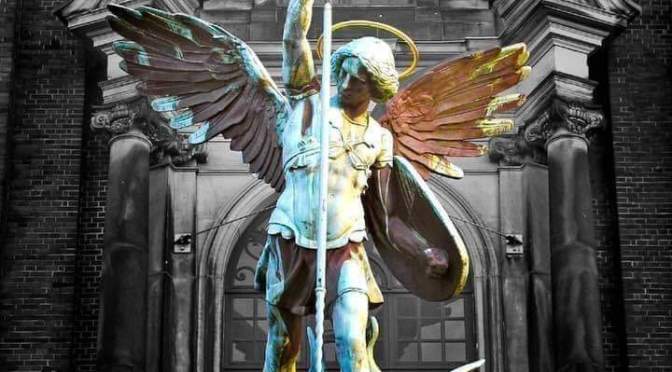
It is not that people believe nothing — they believe anything. Where there had beenorder and good sense now there is the wild torrent of raw emotions that hurls humans to the Unreal. The problem of evil can never be discussed in an academic vacuum. Evil is terribly personal. The disorder we experience is a reflection in space and time of a disorder that began before our world came into being. The conflict that broke out in the heavens before the world was made, that was led on one side by Michael and on the other by Lucifer is still carried on in space and time. This does not mean that men are mere puppets manipulated by demons or that we should think in mere dualistic terms as if Good and Evil were somehow equal and that the outcome of this war is in doubt. God allows evil, the malice of the devils fits into His eternal plan. Even so, the reality of angelic ill-will remains and we cannot hope to begin to come to any understanding of Evil if we leave aside the mysterious personal dimension therein. To quote Shakespeare, . . . “hell breathes forth contagion on the world”. The abominations in our world are only partly man-made. Human malice is not the full explanation. Spirits of a realm of Disorder and Evil and Hate are loose upon the earth. An imaginary observer from outer space looking down in us would see the titanic War of the Spirits — the primal conflict between Michael and Lucifer — carried on in a world of space and time.
In the Second Vatican Council, the Church reminds us: “Since we know not the day nor the hour, on our Lord s advice we must constantly stand guard”. This when we have finished the one and only course of our earthly life we may merit to enter into the marriage feast with Him and to be numbered among the blessed. Thus we may not be commanded to go into eternal fire like the wicked and slothful servant, into the exterior darkness where there will be a weeping and a gnashing of teeth. For before we reign with the glorious Christ, all of us will be made manifest before the tribunal of Christ, so that each one may receive what he has won through the body, according to his works, whether good or evil. At the end of the world, they who have done good shall come forth unto resurrection of life; but who have done evil unto resurrection of judgement.
To DEGRADE
The demonic lie is like a missile aimed at someone or some community that enshrines the Humane, the Beautiful, the Holy, the Good. In his Newsletter, Pastor Wurmbrand described how degradation was the chief weapon the Communists used to dehumanize their victims and the ways they would go about doing that were diabolical — there was a cunning and a hatred out of this world working through all they did.
Degradation can also be psychological, so that the victim loses all sense of personal worth and, as that fades, the will to live shrivels up. The effect on others is to render a person vile and beneath contempt, so that in their eyes, and ultimately in the eyes of the victim, that person has no worth or presence. The assault is against the humanity of the other as devils have a special hatred for anything and everything that is humane.
As He approached the Gerasene boundary, He encountered two men coming out of the tombs. They were possessed by demons and were so savage that no one could travel along that road. With a sudden shriek they cried: “Why meddle with us, Son of God? Have you come to torture us before the appointed time?” (Matthew 8:28-29).
Savage is the word the Holy Spirit inspired to describe the demonic onslaught against Man and all that is humane. The Gospel of Mark describes the dehumanization of the men who were possessed.
“They came to Gerasene territory on the other side of the lake. As He got out of the boat, He was immediately met by a man from the tombs who had an unclean spirit. The man had taken refuge among the tombs; he could no longer be restrained even with a chain. In fact, he had frequently been secured with handcuffs and chains, but had pulled the chains apart and smashed the fetters. No one had proved strong enough to tame him. Uninterruptedly night and day, amid the tombs and on the hillsides, he screamed and gashed himself with stones.” (Mark 5:1-5).
To DIVIDE
Heaven is the community of all who love God, and our destiny. That is why community on earth — any community that truly deserves that name (not an organization merely, or a group or, still less, a mob) is always an earthly preview of what awaits us in the world to come. Community is, therefore, a prime target of demons.
This, too, is the thrust behind dissent within the Church (no matter what glorious and even sublime rhetoric), this tearing apart of the Church is couched in. The onslaught against community and, most of all, against the primal community of the family is one of the ways that powers of darkness carry on their endless war against God and His Creation.
Father Rutler, a well-known preacher and defender of the Faith (he had been a devout Anglican) put this well:
“Satan knows however that he can inch society away from heavenly strength by three assaults.
First, he attacks the Blessed Sacrament. The consecrated Host is the most vivid presence of God we have on earth. Old Scratch cannot stand it. For as malign voices shrieked whenever Jesus got close during His earthly ministry, so it is not uncommon to find disturbed and even criminal personalities drawn by a dread fascination whenever the Blessed Sacrament is exposed. Satan tried to annihilate Christ and his obsession with the Eucharist is a case of the culprit returning to the scene of his crime; for this reason, the Christian must do all he can to remind himself of the utter holiness in this Holy Sacrifice.
Secondly, old Scratch attacks the priesthood. (Dignity of the Priesthood) Priests mediate between God and the human race. They contact us with the sublime, and that is precisely what the Great Deceiver does not want. So he will tell us that the Church is wrong to have priests. Or that if everyone cannot be a priest then no one should be one. Or that Christ was culturally limited in the way He structured Church order. Or that since priests are sinful as everyone else, they cannot mediate. The priest knows this better than anyone, and Scratch wants no one to know it. So he will plot to turn the priest into a manager, or cheerleader, or psychiatrist, or politician, without his clerical clothes which are a sign of contradiction and let him no longer be called Father. For Satan cannot stand fathers. He rebelled against his once and does not want to be reminded.
Thirdly, old Scratch attacks the holy names of Jesus and Mary. They are more powerful than Scratch and he knows it. Mary helps and Jesus saves. Invoke their names with faith and all will be well. But Satan does not want us to know that. He wants us to be in awe of no one, and only in fear of himself. The Prince of Darkness would keep us away from the castle from whose windows the King and Queen pour light.”
To DEFILE
Persons and places become poisoned with rancor, suspicion, anger and hate; they become horrible in a strange unearthly way; there is some indefinable soul-corruption there. Demons defile the world. In a moment of rare honesty among many artists, Picasso once admitted how depressed he had allowed himself to become.
“In art the mass of the people no longer seek consolation and exaltation, but those who are refined, rich, unoccupied, who are distillers of quintessences, seek what is new, strange, original, extravagant, scandalous. I myself, since Cubism and before, have satisfied these masters and critics with all the changing oddities which have passed through my head, and the less they understood me, the more they admired me. By amusing myself with all these games, with all these absurdities, puzzles, rebuses, arabesques, I became famous and that very quickly. And fame for a painter means sales, gains, fortune, riches. And today, as you know, I am celebrated, I am rich. But when I am alone with myself, I have not the courage to think of myself as an artist in the great and ancient sense of the term. Giotto, Titian, Rembrandt, were great painters. I am only a public entertainer who has understood his times and exploited as best he could the imbecility, the vanity, the cupidity of his contemporaries. Mine is a bitter confession, more painful than it may appear, but it has the merit of being sincere.”
To DESTROY
When Jesus met the two men possessed by demons, the Gospel tells us that they were ” …so savage no one could pass that way.” Violence is the mark of Satan. Violence is not of the body only – beating, robbing, killing – but also, and indeed, most of all, the violence of reviling, of harassing, of tearing down, of tale-bearing, of mockery, of sneering, of hate. Our Blessed Lord summed up the demonic in one line. He said of Satan that, “… he was a murderer from the beginning.”
The word of God projects a struggle, a war, between opposing forces. St John, for example, constantly speaks of light and darkness, life and death. Against Christ appears the great Adversary who is, in Our Lord’s own words, ruler of this world. With Satan are arrayed the earthly powers, those who hate the light and become instruments of Satan against God. Jesus Christ
Comment: As the priest interviewed in the video indicates, silence is not an option at this late stage in the crisis. We must all speak out now, in every way possible, to highlight the “new pathways” being pursued by Pope Francis, to create what is, in fact, a new Church, opposed to the Church founded […]
Priest: Fatima Warnings Fulfilled in Amazon Synod – Worst Fears Realised… — Catholic Truth

Pray for your local priests that they may always celebrate the Holy Eucharist with us worthily.
PETER TOROT
Feast Day: July 7
Beatified: January 17, 1995
Venerated: April 2, 1993
 Peter ToRot was born in 1912 in a village named Rakunai in what is today Papua New Guinea. The region had for some time been visited by Christian missionaries, but Peter’s father, Angelo To Puia, who was chief of the village, and his mother, Maria la Tumul, were baptized as adults and were among the first Catholics in the country.
Peter was one of six children, and from an early age he was very interested in his faith.

Because of this, he was trained to be a catechist, a teacher of religion. So when Peter was 18 he became a student at St. Paul’s Mission School. He was a very good student and became a catechist within three years, the youngest of all the catechists in Papua New Guinea. He worked with the people of Rakunai and was known to be an excellent teacher. Peter always carried a Bible with him and knew much of it by heart. In 1936 he married Paula la Varpit, a Catholic from a nearby village. They had three children, but only his daughter, Rufina, survived past childhood.
World War II changed the lives of the people of Papua New Guinea forever. The Japanese forces occupied the island nation, and all missionaries were imprisoned. This left Peter as the only spiritual leader of all Catholics in the area. He provided prayer services, instruction, the Eucharist and Baptism, and helped the poor. He built a church for Catholics from tree branches, the only material available. When people were afraid, he reminded them that God was with them.
In 1942, the Japanese forbade all Christian worship and any type of religious gatherings, even those in homes. They wanted the local chieftains to cooperate with them and tried to push the tribes back to their pre-Christian forms of life, including such practices as having several wives. Peter’s older brother supported this. But Peter did not, and when he became loud in his protests and was known to hold Catholic prayer services in caves, he was seen as a problem for the Japanese. In 1945 he was arrested and sentenced to several months in prison.
But the Japanese leaders had no intention of allowing Peter to leave prison, because his catechetical work and the support people had for him was too dangerous to their cause. At one point he told his visiting wife and mother that a Japanese doctor had been called to give him medicine, even though he had not been sick, and he believed he would be killed. He told his family that he would die for the Church.
He was praying when men came for him. Witnesses say he was given a drink and an injection, and his mouth was covered. The next morning, Japanese authorities acted very surprised to find Peter To Rot dead. But marks on his body and other signs made it clear he had not died of natural causes.
He was given a chief’s funeral in the Catholic cemetery, but the funeral was held in silence because people feared the Japanese. From the day of his funeral, he was seen as a martyr for the Catholic faith.
On January 17, 1995, Pope John Paul II visited Papua New Guinea to celebrate the beatification of Peter To Rot.


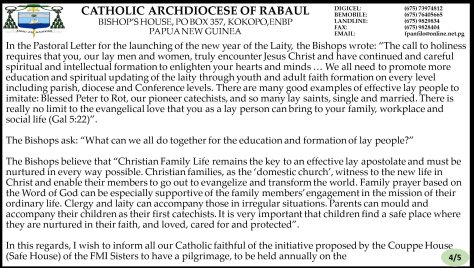
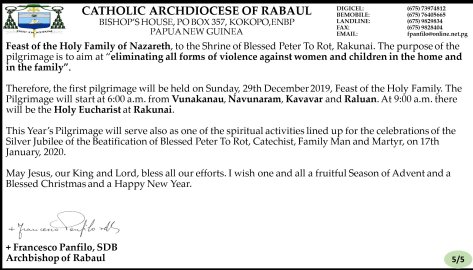
PASTORAL LETTER 11
I am writing this Pastoral Letter on Holy Saturday, in between hours of confessions and rehearsals for the great Paschal Vigil that celebrates the glorious resurrection of Jesus.
In these past weeks I have celebrated the Chrism Mass both at Pomio, on 11th April, and at Vunapope, on 18th April. In both celebrations there was a very large participation of people and this was very encouraging, especially for us priests, because we felt supported and help by our Catholic faithful.
In these days, too, I was very much impressed by the participation of people to the Mass of the Last Supper, as well as to the Way of the Cross on Good Friday morning, and the Veneration of the Cross in the afternoon. I am aware that the same participation of people was experienced by all our priests in their respective parishes.
But the reason for writing this Pastoral Letter is because in these days I have come across a letter that St. John Paul II wrote to the priests of the world in 2004. In that letter St. John Paul II reminded the priests of the world of the link that exists between the Eucharist and the priesthood, a link which began in the Upper Room, that Holy Thursday, when Jesus gathered his apostles to celebrate the Passover meal: these two Sacraments were born together and they will be together until the end of the world. At the Last Supper, priesthood was born: Priests were born from the Eucharist. “There can be no Eucharist without the priesthood, just as there can be no priesthood without the Eucharist”. The ordained ministry enables the priest to act in persona Christi. This is an extraordinary reality and we are overwhelmed by the humility by which God “stoops” in order to unite himself with us!
St. John Paul II wrote: “If we feel moved before the Christmas crib, when we contemplate the Incarnation of the Word, what must we feel before the altar where, by the poor hands of the priest, Christ makes his Sacrifice present in time? We can only fall to our knees and silently adore this supreme mystery of faith … The Eucharist is a mystery of faith, yet the priesthood itself is also a mystery of faith. At the beginning of his public life, the Messiah called the Twelve, appointed them ‘to be with him’ and sent them out on mission. At the Last Supper, this “being with” Jesus on the part of the Apostles reached its culmination. By celebrating the Passover meal and instituting the Eucharist, the divine Master brought their vocation to its fulfilment. By saying ‘Do this in memory of me’, he put a Eucharistic seal on their mission. Quite rightly, then, the Christian people give thanks to God for the gift of the Eucharist and the priesthood”.
Promotion for Priestly Vocations!
From the Upper Room Christ continues to seek and call. Unfortunately the number of priests, even here in our Archdiocese of Rabaul where, thanks be to God, we have a good number of vocations, is never sufficient to meet the demands of evangelization and the pastoral care of the faithful. For this reason I ask all the Catholic faithful of the Archdiocese to pray and work actively to promote vocations so that priests will never be lacking in the Church.
In his letter St. John Paul II was calling on Priests to be the first ones responsible in the pastoral promotion of priestly vocations, ready to help all those whom Christ wishes to associate to his priesthood to respond generously to his call.
He proposed two things to the priests: Personal fidelity of priests and care for altar servers!
• Personal fidelity of priests is indispensable. St. John Paul II wrote: “What counts is our personal commitment to Christ, our love for the Eucharist, our fervour in celebrating it, our devotion in adoring it and our zeal in offering it to our brothers and sisters, especially to the sick. Jesus the High Priest wishes to count on our active cooperation. Priests in love with the Eucharist are capable of communicating to children and young people that “Eucharistic amazement”. Generally these are the priests who lead them to the path of the priesthood, as the history of our own vocations might easily show.
• With this Pastoral Letter, therefore, I ask all our priests to show special care for altar servers, who represent a kind of “garden” of priestly vocations. The group of altar servers can be given a valuable experience of Christian education and become a kind of pre-seminary. Although the Archdiocese, following the Instruction Redemptionis Sacramentum of Pope Benedict XVI, allows girls or women to service at the altar, the practice of having boys as altar servers should not only be preserved but introduced where it does not exists. Priests should help the parish, as a family made up of families, to look upon the altar servers as their own children, like “olive shoots around the table” of Jesus Christ, the Bread of Life.
A Tabernacle in Every Catholic Community!
In these past days of prayers and reflection, especially during the Holy Thursday, I thought about all my predeccessors and how much they must have wished to see that the Sacrifice of the Mass could be celebrated in every community. That wish or dream remained for them and it remains for me too “our long-range objective”. For this reason, I encourage the faithful to continue praying for vocations, so that the Lord of the harvest may send labourers into his harvest, so that one day all our Catholic communities could have the Mass, at least every Sunday. In the mean time, we will do everything “to ensure that the Sacrifice of the Mass is made available as often as possible to the faithful who are regularly deprived of it” (Dies Domini, 53).
Instead “our short-range objective” is to provide a tabernacle in every catholic community where the Eucharist is preserved and distributed during the “Sunday liturgy without a priest”.
But in order to have a tabernacle in every Catholic Community, we need:
• To deepen our faith in the Eucharist and in the real presence of the Lord, through a systematic and organic catechesis.
For this, I encourage the Priests, the Consecrated men and women, and in particular the Catechists, to provide catechetical instruction to people on the eucharistic mystery and to do all they can to safeguard the sacred dignity of the Eucharist. It is important, for example, to instruct the faithful with regards to the indispensable conditions for the reception of Holy Communion so as to avoid two extremes: people who could receive Holy Communion and do not, and people who receive it and should not. I believe that in our Catholic communities there are people who could participate in Eucharistic Communion and do not, even though they have no serious sin on their conscience as obstacle. Is it because they feel unworthy or because they lack a kind on interior willingness, a lack of Eucharistic “hunger” and “thirst”? Is it a sign of lack of adequate sensitivity towards the great Sacrament of love and lack of understanding of its nature?
We need to instruct well our faithful, beginning with the children, to encourage them to receive Jesus in Holy Communion as frequently as possible. Our Pastoral Guideliens states clearly that First Holy Communion can given to children who are in Grade 3 or 4, while Confirmation to those who are in Grade 7 or 8.
• To give importance to the Adoration of the Blessed Sacrament.
Our faith in the real presence of Jesus in the Eucharist will lead us to give importance to the Adoration of the Blessed Sacrament. I have visited almost all our Catholic communities and I have seen how, in many of them, the Chapel occupies a very central place in the villages. How easy it would be for people to visit the Blessed Sacrament! And how beautiful it would be if in every chapel some people were to come together once a week for a holy hour of Adoration in front of Jesus in the Blessed Sacrament! I am thinking, for example, of Friday. It is the day when Jesus suffered and died for us; it is the day on which we remember, in a special way, the Sacred Heart of Jesus. There is no better way of expressing our devotion to the Sacred Heart of Jesus than to celebrate the Eucharist and, for those who cannot do so, to gather together in adoration in front of the Blessed Sacrament, drawing from his infinite love for us the strength and power to live worthy Christian lives.
While thanking Jesus for his great gift, let us plead with him not to let us go spiritually hungry for lack of priests. Let us implore him to keep our seminarians and priests free from evil. Jesus will feel twice as happy when our own sons will be the ones to feed us with the Holy Eucharist.
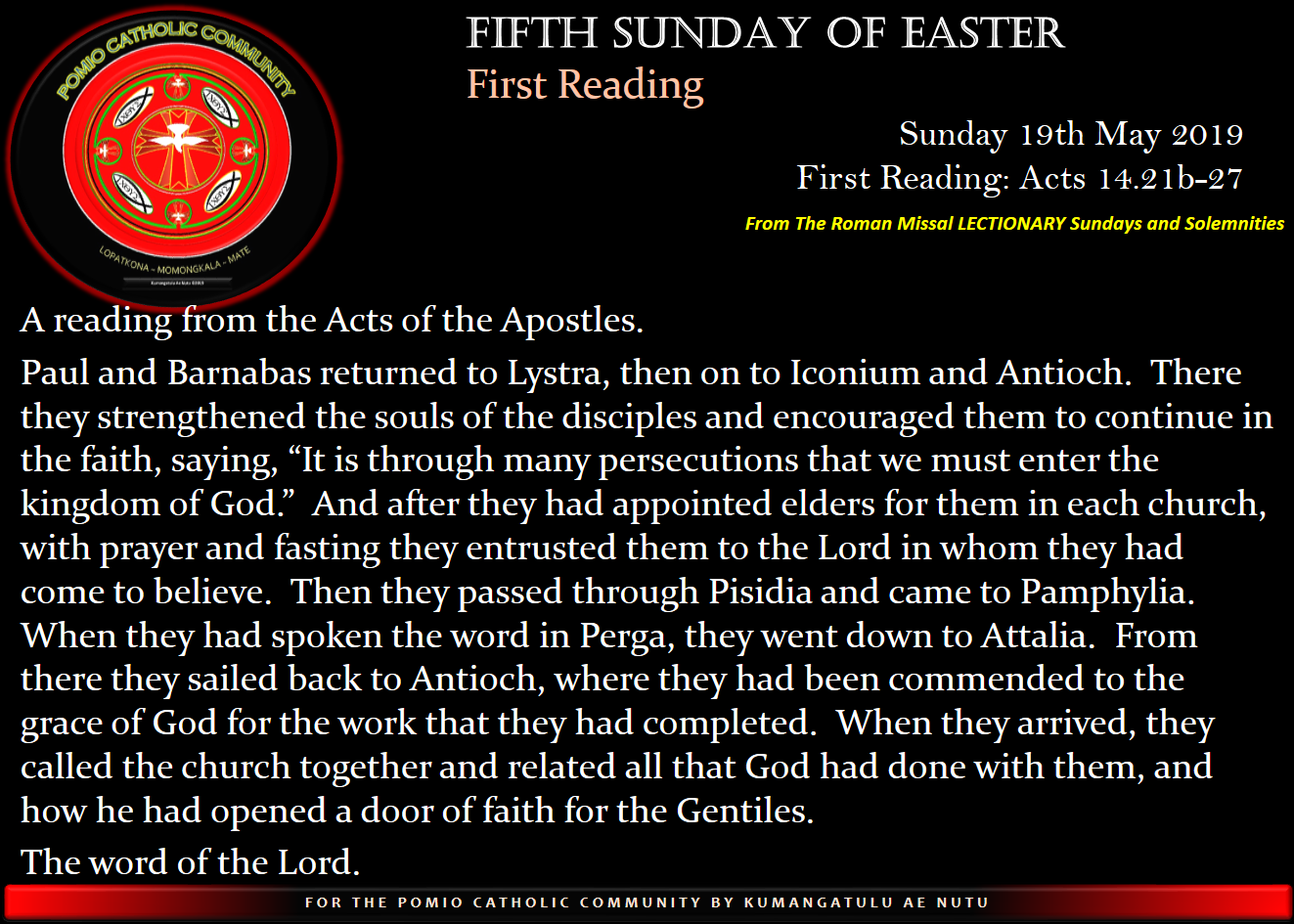
The first reading is taken from Acts 14:21-27. Last week we heard of St. Paul’s experiences at Antioch in Piscidia during his first missionary journey. Their visit had ended on a sour note as Paul and Barnabas were expelled. The reading ended with “the two shook the dust from their feet in protest and went on to Iconium. Their disciples knew only how to be filled with joy and the Holy Spirit”. Today we hear of the conclusion of this first missionary journey where Paul and Barnabas retrace their steps back through Antioch in Piscidia on their way back to Antioch in Syria where they had begun their journey.


The second reading is from the Book of Revelation 21:1-5a. For the past three weeks we have had as our second reading an account of John’s privileged vision of the heavenly liturgy where he has seen the eternal sacrifice being offered to God the Father by His Son, The New and Eternal High priest and sacrifice. We have heard also the prayers being offered by the faithful. We now go to the end of John’s account as he describes the Heavenly Jerusalem. It was Jesus’ mission to go to the earthly Jerusalem to offer His sacrifice — this shows us the path that we must follow to reach the Heavenly Jerusalem so that we can dwell with Him there forever.
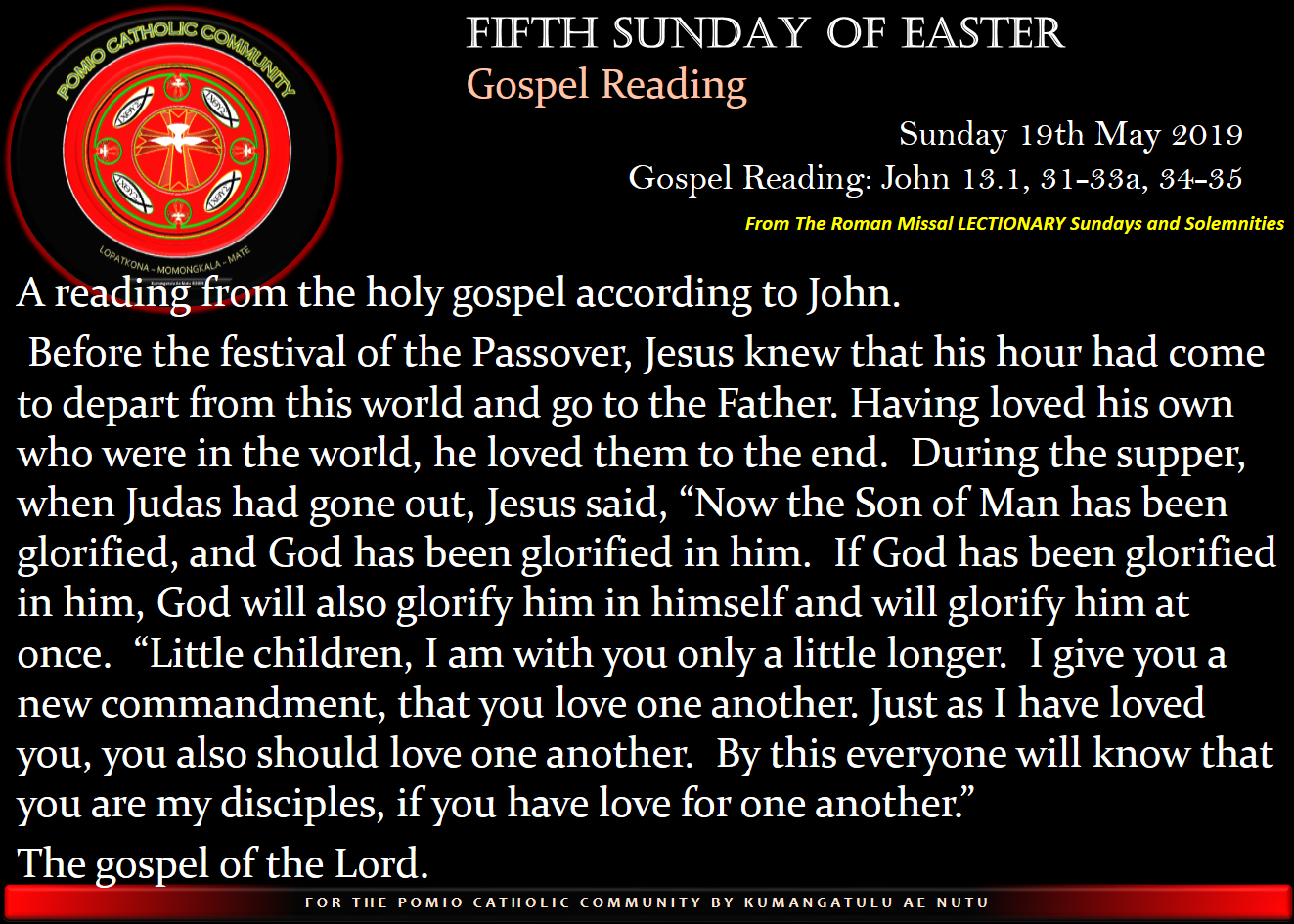
The Gospel is from John 13:31-33a, 34-35.We are disciples, followers of Christ, but how many of us would pass the test that Christ himself lays down for deciding who are his true followers? The word “charity” unfortunately has come to have a very restricted meaning in our present-day vocabulary. It signifies giving an alms, a gift of money to a needy person. This is but a very small part of the true charity, true love of neighbor which Christ made the distinguishing mark of the true Christian. He who truly loves his neighbor must be interested, first and foremost, in those things which concern that neighbor’s most important purpose in life, his eternal salvation.
Here is where so many good Christians fail in true charity. Effective interest in missionary activity is a case in point. Practical help in parochial matters, taking part in the various societies which are intended to build up and strengthen the faith and the devotion of the members of the parish is another obligation of true charity. So many seem to think it is no concern of theirs but it is. Advising and encouraging, with true Christian kindness, a neighbor who is beginning to grow lax in his attendance to his Christian duties, or who is forming habits or alliances which, if unchecked, will bring misery and suffering to his family, and scandal to the neighborhood, and even the possibility of his own eternal destruction, is also an exercise of real Christian charity.
There are thousands of broken homes today which would not be broken if there was true charity in those homes not only in the heart of the offender but in the hearts of the offended. There are thousands in jails and in hospitals of rehabilitation today who would not be there if their families and neighbors fulfilled their obligation of Christian charity. There are many, far too many, lapsed Catholics in the world today, who would not have lapsed had true charity been practised by their relatives and neighbors. And, last but not least, there are millions of people who have remained outside the Church of Christ because the hall-mark of charity which Christ said was its distinguishing mark was tarnished or invisible. Each one of us could, with great profit, spend a few moments today looking into ourselves and comparing our thoughts and our words and our actions with the thoughts, words and actions of love which Christ expects from his followers.
It is never too late to mend. Begin today to take a true Christian interest in the spiritual fate of your family and neighbors. Where words have already failed perhaps, try prayer and example. The grace of God will cooperate with your sincere, charitable effort.
Excepted from The Sunday Readings, Fr. Kevin O’Sullivan, O.F.M.
“…We are God’s people, the sheep of his flock… ”


Isaiah 43:16–21
Psalm 126:1–6
Philippians 3:8–14
John 8:1–11

The first reading is taken from the Book of the Prophet Isaiah, 43:16-21. Last week we heard of the conclusion of the exodus from Egypt; the first Passover celebration in the land of Canaan. This week we look forward to a new exodus that God promises through the prophet Isaiah. The new exodus promises to be far more wonderful than the first. God promises to restore His people after they have suffered in exile.


The second reading is from the Letter of St. Paul to the Philippians, 3:8-14, and is a warning to the Philippians about false teachers; Judaizers who would try to hang on to the old ways while at the same time claiming to be Christians. The Judaizers taught that in order to be a Christian, you first had to be a Jew: to be circumcised and to obey all 613 Old Covenant commandments. This question, whether or not Gentile converts to Christianity must first become full and legal Jews, prompted the Council of Jerusalem.

The Gospel is from St. John, 8:1-11 and is about the woman caught in adultery. “The two of them were left on their own, the wretched woman and Mercy. But the Lord, having smitten them with the dart of injustice, does not even deign to watch them go but turns his gaze away from them and once more writes on the ground with his finger. But when the woman was left alone and they had all gone, he lifted up his eyes to the woman. We have already heard the voice of justice; let us now hear the voice of gentleness. I think that woman was the more terrified when she heard the Lord say, ‘Let him who is without sin among you be the first to throw a stone at her,’ . . . fearing now that she would be punished by him, in whom no sin could be found. But he, who had driven away her adversaries with the tongue of justice, now looking at her with the eyes of gentleness, asks her, ‘Has no one condemned you?’ She replies, ‘No one, Lord.’ And he says, ‘Neither do I condemn you; I who perhaps you feared would punish you, because in me you have found no sin.’ Lord, can it be that you favour sinners? Assuredly not. See what follows: ‘Go and sin no more.’ Therefore, the Lord also condemned sin, but not the woman’ (St Augustine, In Ioann. Evang., 33, 5-6). Jesus, who is the just One, does not condemn the woman; whereas these people are sinners, yet they pass sentence of death. God’s infinite mercy should move us always to have compassion on those who commit sins, because we ourselves are sinners and in need of God’s forgiveness. — The Navarre Bible – St. John
https://pomiocatholiccommunity.home.blog/?p=230(opens in a new tab)



 The Pomio Catholic Community
You must be logged in to post a comment.