Galleries

VOTING OUR REPRESENTATIVE AND NOT A LEADER: A PUBLIC AWARENESS ON PREPARING FOR NATIONAL GENERAL ELECTION 2022

By Mr Basil B. Peutalo, Manager of Caritas Rabaul Office.

Vunapope, June 2021

We will be sharing some important points for understanding of the National General Election, Provincial and Local Level Governments that are taking place next year 2022. National or provincial or even Local Level Government elections though are political matters, are our important Christian duties. All Christians, and for most of us Catholics, have the duty to voting into public office, Provincial Assembly or National Parliament responsible and upright women and men who can represent responsibly, truthfully and sincerely us the voters, the ordinary people who vote them in. 

Bible Readings And Teaching of the Church on Politics:   

Before we go into to the topic, let us listen to one or two Bible texts and the teachings of the Mama Church on politics to help us understand well what and how voting and participating in politics are our christian duties.

Politics are polarizing, that is, dividing our thoughts, focus and us in communities because the different opinions about the role of government, performance of our mandated representatives and application of laws run such a wide—and impassioned or with strong feelings — spectrum of beliefs and philosophy.

Thankfully, for Christians, the Bible isn’t silent on these issues. The Mama Church has clear and strong stance on politics also in line with the Bible. The Bible and the Church put up the Gospel Values as guiding principles for Christians to use as guidance for them while participating in social, economic, cultural and political developments for themselves and their country.

Here are some important points that the Bible wants us to understand about our roles in politics and governments.

The first truth is that the will of God permeates, that is present all over or throughout and supersedes, that is, above all and every aspect of life. It is God’s will that takes precedence, that is, first place or priority over everything and everyone (Matthew 6:33): “Set your heart first on the Kingdom of God and all these things will be given to you”. God’s plans and purposes are fixed, and His will is inviolable, that is unbreakable, or sacred. What He has purposed, He will bring to pass, and no government can frustrate or prevent His will (Daniel 4:34-35): “So now, I, Nebuchednazzer, praise, exalt and glorify the King of Heaven. For all His works are true, and His ways are all just; He knows how to humble those who walk in pride”. In fact, it is God who “sets up kings and deposes them” (Daniel 2:21) because “the Most High is sovereign over the kingdoms of men and gives them to anyone he wishes” (Daniel 4:17). A clear understanding of this truth will help us to see that politics is merely a method God uses to accomplish His will. Even though evil men abuse their political power, meaning it for evil, God means it for good, working “all things together for the good of those who love him, who have been called according to his purpose” (Romans 8:28).

Second, we must grasp the fact that our government cannot save us! Only God can. We never read in the New Testament of Jesus or any of the apostles expending any time or energy schooling believers on how to reform the pagan world of its idolatrous, immoral, and corrupt practices via the government. The apostles never called for believers to demonstrate civil disobedience to protest the Roman Empire’s unjust laws or brutal schemes. Instead, the apostles commanded the first-century Christians, as well as us today, to proclaim the gospel and live our lives that give clear evidence to the gospel’s transforming power.

There is no doubt that our responsibility to government is to obey the laws and be good citizens (Romans 13:1–2): “Let everyone be subject to the authorities governing us. For there is no authority that does not come from God, and the existing ones have been established by God. He who therefore resists authority goes against the order established by God, and those who resist deserve to be condemned”. God has established all authority, and He does so for our benefit, “to commend those who do right” (1 Peter 2:13–15): “For the Lord’s sake, respect all human authority: the king as chief authority; the governors as sent by God to punish evil-doers and encourage those who do good. And God wants you to do good so that you may silence those fools who ignorantly criticize you”. Paul tells us, as we have heard already in Romans 13:1–8 that it is the government’s responsibility to rule in authority over us—hopefully for our good—to collect taxes, and to keep the peace. Where we have a voice and can elect our leaders, we should exercise that right by voting for those who best represent us and best demonstrate Christian principles.

One of Satan’s grandest, that is, outstanding deceptions or lies is that we can rest our hope for cultural morality and godly living in politicians and governmental officials. A nation’s hope for change is not to be found in any country’s ruling class. The church has made a mistake if it thinks that it is the job of politicians to defend, to advance, and to guard biblical truths and Christian values. This means that the Church must keep preaching the Word of God, that is, the Gospel and its values against which government and public officers must align public policies and social, economic, cultural and political development goals. The Word of God must cut deeply through government systems to challenge for beneficial changes for Christian values in those systems and programs. Our Christian mandate is to spread the gospel of Christ and to preach against the sins of our time. Only as the hearts of individuals in a culture are changed by Christ will the culture begin to reflect that valuable change that is acceptable to God.

The church’s unique, God-given purpose does not lie in political activism that is engagement or involvement. Nowhere in Scripture do we have the directive to spend our energy, our time, or our money in governmental affairs. Our mission lies not in changing the nation through political reform, but in changing hearts through the Word of God and its values. When believers think the growth and influence of Christ can somehow be allied with government policy, they corrupt the mission of the church. Our Christian mandate is to spread the gospel of Christ and to preach against the sins of our time. Only as the hearts of individuals in a culture are changed by Christ will the culture begin to reflect that valuable change that is acceptable to God.

Believers throughout the ages have lived, and even flourished, under hostile, repressive, pagan governments. This was especially true of the first-century believers who, under merciless political regimes, sustained their faith under immense cultural stress. They understood that it was they, not their governments, who were the light of the world and the salt of the earth. They adhered to Paul’s teaching to obey their governing authorities, even to honor, respect, and pray for them, that is the governing authorities in the world (Romans 13:1-8). More importantly, they understood that, as believers, their hope resided that is, rested in the protection that only God supplies. The same holds true for us today. When we follow the teachings of the Scriptures, we become the light of the world as God has intended for us to be, whether in social, economic, cultural or political development as we read in (Matthew 5:16): “In the same way your light must shine before others, so that they will see the good things you do and praise your Father in Heaven”. Political entities are not the savior of the world. The salvation for all mankind has been manifested in Jesus Christ. God knew that our world needed saving long before any national government was ever founded. He demonstrated to the world that redemption could not be accomplished through the power of man, economic strength, military might, or political cleverness. Peace of mind, contentment, hope, and joy—and the salvation of mankind—are provided only through Jesus’ death and resurrection. This means that any and all human initiatives that are carried out for the good of all in social, economic, cultural and political areas must be truly aligned with the Gospel Values as preached and brought about by the saving power of Jesus Christ and fulfilled in His death and resurrection. Any other way, that is through mere human efforts and earthly design for the sake of only the social, economic, cultural and political reasons is not of God.

The Church teaches this fundamental lesson that all human systems, governments and initiatives must be enriched and challenged by the Gospel Values, that is, the love of God that is shown through the passion, death and resurrection of our Lord Jesus Christ. This must be undertaken and promoted always as the values of Christians, baptized Christians who believe and follow Christ in their thoughts, words and actions here on earth. 

WHAT IS THE THINKING AND ROLE OF THE CHURCH IN POLITICS?

Following on from what the Gospel of Christ has required of us in public arena, the Church likewise instructs us to apply this type of mentality and approach to public office and political undertakings as individuals and collectively as voters.

Principled leaders, that is, leaders with integrity, honesty and transparency guide a nation into responsible action for equal benefits from public programs and project. And it is responsible action that honors principles, that is values, enabling others to understand and appreciate them. 

Thus, for example: the principle or value of economic security generates job creation. But if education and crime prevention are inadequate, economic security is impacted negatively or adversely or wrongly. 

Thus, for example: the principle or value of integrity fosters responsible and honest leadership for the common good. But if the governance and its systems are not respected and protected to run its correct courses, delivery of services to one and all in the country is distorted or misapplied and destroyed leaving lots of our people in the rural areas suffering.

Thus, for example: the principle or value of honest and transparent elections fosters caring and conscionable elected representatives and good governance. But if the electoral system is abused and corrupted, government and its systems are destroyed and corrupted as a result.

Hence a vicious circle is created with little or nothing done to produce meaningful life in the land. Many instances in PNG can be used to understand this reasoning and can be safely said that such inadequate education and crime prevention, corruption in electoral systems and governance and its systems are not respected undermine terribly any effort to develop a so called “Christian rich black nation of Papua New Guinea”.

And what is the role of the church in such situation? We have to speak and act, we have to engage government on moral terms, not on expediency or seeming interference. That is our calling as the body of Christ here on earth. That is our calling as the teachers of the values of the Gospel of Christ here on earth.

Christians in the political arena have to commit themselves to honesty and integrity in all areas of their lives including politics to show by example that following Jesus works for our betterment even on earth. The church, as institution, needs to have competent lobbyists, that is, baptized and committed Christians within government structures to inform and be informed about the issues of the day. This must be seen as an investment, not a costly luxury for the Kingdom of God here on earth. 

To conclude:

The Church’s role in politics is to be there visibly in the context of political policy formulation. That is, the Church as an institution and as represented by baptized and committed Christians must always keep alert in ensuring the government policies and regulations are inspired and based on the Gospel values for the good of everyone. The church has to be prophetic, speaking for God in today’s social, economic, cultural and political needs. The church has to herald the ethical values that enrich a nation through national social, economic, cultural and political development initiatives. The church has to be bold and forthright, constructive and innovative. The church has to be “salt and light” in what is so often a corrupt environment, to bring light and health to one and all here on earth, our common home.

Active participation of all citizens in their political development initiatives such as National General Elections, Provincial and Local Level Government elections is defined by the Church as “characteristic implication of subsidiarity….” That is, citizens either individually or in association with others whether directly engage in individual development initiatives or through representation on the floor of Parliament or Provincial Assembly Hall contribute to the cultural, economic, political and social life of the civil community to which s/he belongs. “Participation is a duty to be fulfilled consciously by all, with responsibility and with a view to the common good” (Catechism of the Catholic Church, 1913 – 1917). 

THINGS TO REMEMBER DURING TIME FOR VOTING

When voting, exercise your right and duty responsibly with determination. We must always observe some of the following key points during election times be it National General Election, Provincial and or Local Level Government elections. 

SOME KEY POINTS TO KEEP IN MIND WHEN VOTING

  • All citizens of Papua New Guinea, both those who are natural by birth and those who are naturalized through the law.
  • Natural citizens are those of us whose parents are born here in Papua New Guinea, and can trace our lineage or traditional relations back to our ancestors and past generations, villages and clans here in PNG.
  • There are our fellow PNG citizens whose country of origin, parents and ancestors are from a foreign nation but have taken out citizenship by law in PNG.
  • We all have the right and duty to vote.
  • If you are 18 years and above, you have the right and duty to vote at National General Election or Provincial and Local Level Governments.
  • Both men and women who are eligible, that is have the right age and correct citizenship can and must vote at National General Election or Provincial and Local Level Governments.
  • Any male or female who is below 18 years of age, and who is not mentally fit to think clearly or are too old cannot vote.
  • Let us elect NOT A LEADER BUT OUR REPRESENTATIVE!  I repeat this: Let us not elect a leader but a representative or mausman na mausmeri to represent us in National Parliament, Provincial Assembly and or Local Level Government.

Why not a Leader? 

  • A LEADER dictates, directs and command respect and obedience from the ordinary people. As we say in Tok Pisin, a leader is someone husat igo pas, na yumi bihainim tasol.
  • A Leader presides over his or her people and their well being.
  • A Leader is expected to provide for his or her people.
  • A Leader performs the role of delivering of goods and services using “provision”approach and mentality for her or his people’s development without the people’s participation, making them become dependent.
  • Those whom we elect at National General Election day are not, should not and must not be the modern version of the traditional chief or the elder; nor are they elected on prestige, that is title or name or status in the clan or tribe, but competence, that is, ability to first of all understand the needs of her or his people, then speak, articulate well and clearly the needs of his or her people.
  • A REPRESENTATIVE represents the silent majority, is a mouth piece, speaks up on behalf of his or her ordinary people who are busy or worst overburdened with their day to day social, economic, cultural and political concerns.
  • A REPRESENTATIVE facilitates development and delivery of services through enabling approach, that is, making his or her people empowered to helping themselves with him or her making it possible through enactment of appropriate laws and policies at government levels. 
  • We are voting REPRESENTATIVES inline with the Preamble of the PNG Constitution that says: “… all power belongs to the people – acting through their duly elected representatives” (Preamble To The PNG National Constitution).
  • The power is ours – us the ordinary people who are voting. We invest this power into the one whom we elect as our representative in the National Parliament or the Provincial Assembly or the Local Level Government.
  • Our representatives are mandated or empowered by us the voters, that is, members of our communities to speak on our behalf on the floor of Parliament, Provincial Assembly or the Hall of the Local Level Government. That is why we call our political system in PNG as representative democracy. It adopts the British parliamentary system where representatives are elected to represent their voters in Parliament. We all cannot go to parliament to make laws to address our social, economic, cultural and political needs and issues.  
  • The 111 members of Parliament debate, advocate, and vote on our behalf: for us their voters, their electorate first and for the whole nation.
  • The men or women we are sending to Parliament do not need to be the richest in the district, nor the ones with the best rhetoric or ability to win in talking, or many years of life abroad and in the international circles.
  • What really matters is their knowledge of the area and us the people and have the heart for how to push forward urgent and valuable pieces of legislation for our good.
  • The good representatives listen a lot.
  • The good representative will show up back home anytime the Parliament is in recess and no other duty or follow-up engagement keeps them back in the capital city. 
  • Let us vote for REPRESENTATIVES who enable us to helping ourselves instead of voting for LEADER who provides for us or drag us along behind him or her or spoonfeed us in our development needs.
  • Importantly, we are not going to vote leaders, as commonly understood. We vote representative. Repeat, we are voting our representative to National Parliament, to Provincial Assembly and Local Level Government.
  • It is not only a privilege and right but a duty to vote our representative to the National Parliament or Provincial Assembly and or the Local Level Government.
  • Choose wisely and choose freely is the golden rule in going to the polls or when voting.
  • It is not a festival nor a traditional singsing nor a feast. 
  • Voters may be tempted to go for the most cunning and unscrupulous, those who might come with a bag of rice today but soon disappear into Port Moresby or Brisbane or Singapore only to show up again at the next election. 
  • Every five years or at the most every ten years better choose new representatives, unless the performance and the service (not the cash outs) of the incumbents that is, the representatives that we voted in have been outstanding. 
  • It is time to go for women candidates, especially when they better understand the needs of the families, Local Level Government, district, and the Province.
  • Our women are not in private business, and reveal a higher level of empathy that is, share the concerns, needs and issues with the people. 
  • The ideal ones – men and women – are people from the health and education sectors, labor unions, the legal system, the international relations, the administration of the State, the community services, and the social welfare. With leadership skills, of course!
  • What is needed is a Parliament that passes laws and enforces policies and behaviors which benefit and transform the individuals, the community and the country at large.
  • People with vested interests instead, though with a few exceptions, will tend to secure their own profit and future, to bend the nation to their own objectives and goals.
  • They will make you happy with a donation today, but they will not transform your community, district, province and the country and develop it for the benefit of our children.
  • Some commentators already anticipate that the 2022 elections will be the hardest fought and the bloodiest in PNG history. And that is because of greed. The only way to prevent this happending, is that we prepare to dump all those who register their name for whatever reason other than the service of the people and the good of the country.
  • The voters will only consider as second-choice if at all, candidates those who have been away from their place of origin for years. In other words, if you are to vote for a candidate who have been away from their place of origin for years, it must be because you have no other suitable person standing, a person who knows and understands well your peoples needs, concerns and issues.

KEY POINTS TO REMEMBER

Let us remind ourselves again of the key points of the importance of our participation in politics.

  • First and foremost, our participation in politics is our duty and right of a citizen by being willing to stand for election as people’s representative. Any citizen who is of sound mind and eligible age can stand for public office in the government of Papua New Guinea.
  • Our participation in politics is our Christian duty and right that have the common good of all as ultimate goal and purpose, and not for selfish and personal reasons.
  • Politics is a noble profession. This means that the purpose of politics is that the REPRESENTATIVE speaks up and enables sustainable development for her or his people, who have mandated or given her or him their power as enshrine in the Mama Lo as their representative in Parliament or Provincial Assembly.
  • Vote for our REPRESENTATIVE and not for a LEADER. There is a big difference between a REPRESENTATIVE and a LEADER.  
  • Our REPRESENTATIVE is empowered that is, given power by us through our votes to speak on our behalf about our concerns, needs and dreams for development in our lives and communities.
  • In this regard, our REPRESENTATIVE facilitates for our development. 
  • LEADER provides, hence spoon feeding her or his people to becoming dependent, and expectant always while REPRESENTATIVE enables her or his people to be strengthened and taking responsibility of their own development.
  • Both women and men can and should stand for public office, and not only men or not only women, or not anyone from any one particular area or profession only.

CONCLUSION

Before we conclude, let us hear about how principled leaders or leaders with integrity who have hearts for their people and their people who are inspired and enriched with Gospel values taking action to change their cruel and dictatorial rules to establishing democratic governments – government of the people and by the people . These political events took place in the one neighboring East Asian country of the Republic of the Philippines. 

  1. How Filipino People Power toppled dictator Ferdinand Marcos

In 1986, over a million Filipinos took to the streets to overthrow the corrupt and brutal regime of President Ferdinand Marcos. It was called the People Power Revolution. President Marcos and his wife Imelda had ruled the Philippines for 20 years. Following the murder of the anti-Marcos politician, Ninoy Aquino, a huge opposition movement rallied around his widow, Cory Aquino. She stood against Marcos in a snap presidential election in 1986. But when Marcos was declared the winner amid massive electoral fraud, huge protests began. The protestors were supported by the Catholic Church under the guidance of Cardinal Jaime Sin. Eventually, senior members of the army rebelled against Marcos. Filipinos poured onto the streets to protect the rebel army officers. Loyal troops refused to fire on the crowds. After four days of mass protests, Marcos fled to Hawaii.

You can read more about this political revoluation in the Republic of the Philippines yourself.

This political action by the people and their leaders though had the potential for much violence, gained their desired outcome of overthrowing President Ferdinand Marcos through non-violent ways and means. During its rul the government of President Ferdinand Marcos engaged in lots of brutal and violent murders of their opponents over his 20 years rule. Lots of people just mysteriously went mission, died and thrown into prison when and if they talked out against the way the government was running their country. The people had enough and took to the main street of Metro Manila and protested, overthrew the Marcos Government and they won.

The people of the Republic of the Philippines took up political actions because they assessed that there had been too much injustices through abuse and disrespect for the people and their basic human rights by the political power of former President Ferdinand Marcos at that time. The leaders, both public and private of the Republic of the Philippines wrestled, that is take away the political power from their ruling government of former President Marcos for the benefit of the silent suffering majority of their peoples. They took non-violent ways of ousting or getting rid of their government.

One factor in the so called Peoples’Power in the Republic of the Philippines is that the leaders and the majority of the people who take the Gospel values with the Social Teachings of the Church into their day to day lives and apply these values to their social, economic, cultural and political lives even to the present time.

Let us pray as we conclude;

O God bless us all and guide us with the Holy Spirit in our preparation and participation in all our social, economic, cultural and political development duties of our people, country, Papua New Guinea and for Your glory and Kingdom here on earth.

We make this prayer in the holy name of Jesus Christ Our Lord.  AMEN.

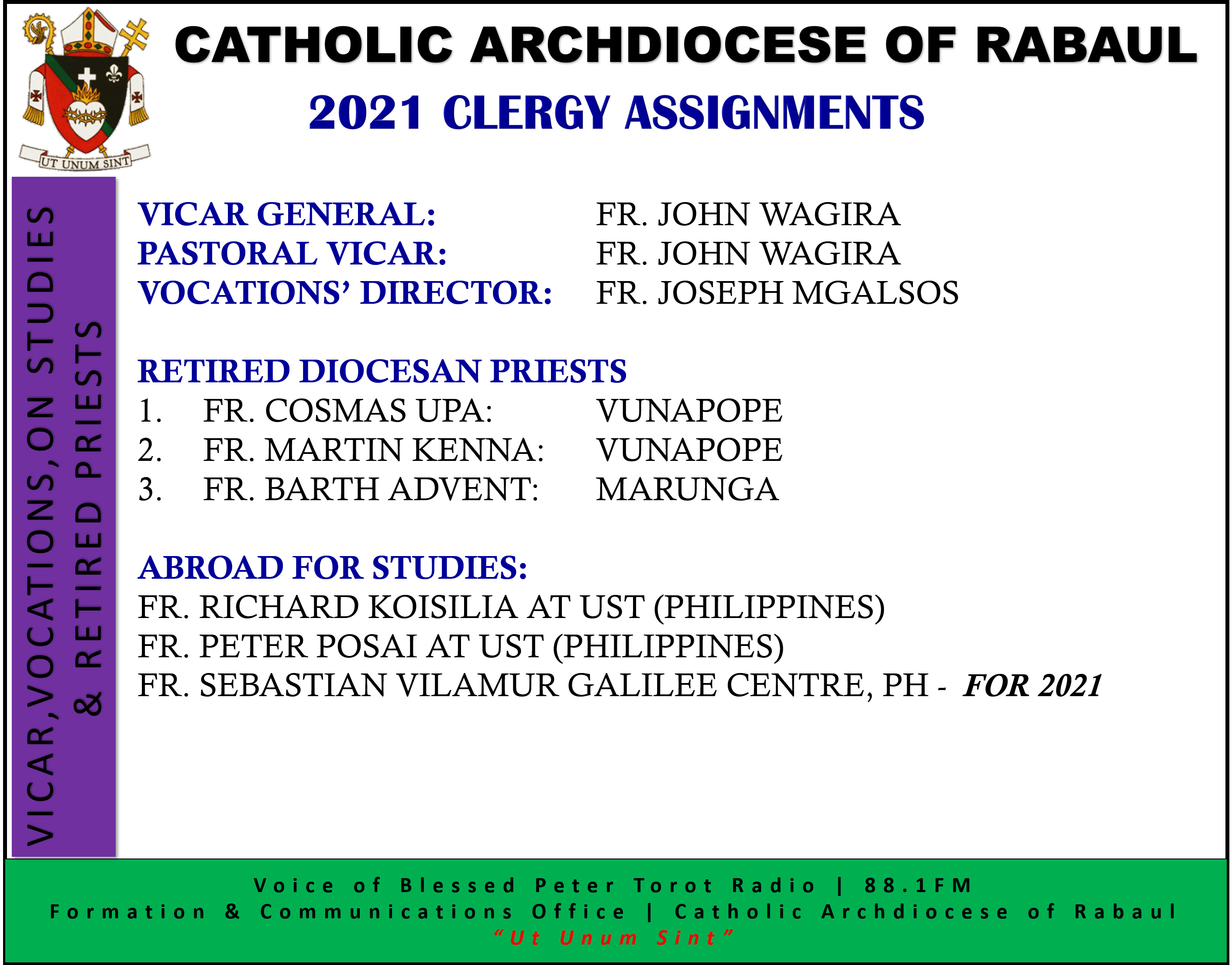
Catholic Archdiocese of Rabaul Clergy Postings for 2021

Pomio Deanery Parishes and Priest Assignment for 2021.

Kokopo Deanery Assignments for 2021.

Rabaul Deanery Parishes and Priest Assignments for 2021.

Vicar General, Pastoral Vicar, Retired Priests and Priests away for studies.

Catholic Institution Chaplaincies and Rectors 2021.

From the Voice of Blessed Peter To Rot, Formation and Communications Office of the Catholic Archdiocese of Rabaul

The Homily of His Grace Archbishop Francesco Panfilo SDB at Mass for the SIXTH SUNDAY IN EASTER – Sunday 17th May 2020.

Given in Tokpisin at the Sacred Heart Cathedral Vunapope.

SANDE 6 BILONG ISTA (A)

Olsem wanem wanpela i ken save olsem narapela i laikim em? Wanem samting i soim olsem wanpela i laikim narapela? Hau papa i save olsem pikinini i laikim em? Hau pikinini i soim laikpasin i go long mama? Hau yumi ken soim long God olsem yumi laikim em tru? I gat wanpela rot tasol na i gat wanpela tes tasol bilong painimaut olsem yumi laikim narapela o nogat. Dispela rot na tes em i pasin bilong harim tok. Long Gutnius tude Jisas i tok: “Man o meri i kisim lo bilong mi na i bihainim gut, dispela man o meri i laikim mi tru” (Jo 14; 21).

Planti taim Jisas i bin skulim ol manmeri long pasin bilong laikim. Em i bin tok long pasin bilong sori na marimari long narapela. Em i bin tok long pasin bilong helpim na pogivim narapela. Em i tok long pasin bilong daunim yumi yet na kam klostu long narapela. Gutnius bilong em i pulap tru long dispela gutpela tok. Na moa yet. Jisas i no bin lusim yumi wantaim gutpela tok tasol. Nogat. Long laip bilong em yet, em i bin soim oltaim dispela pasin bilong laikim narapela. Em i bin mekim orait ol sikmanmeri, em rausim ol spirit nogut long ol na pogivim ol sin bilong ol.

Wanem samting moa Jisas i bin mekim long soim olsem pasin bilong laikim i pulap tru long laip bilong em? Em i soim pasin bilong harim tok bilong Papa. Yes, em i bin harim tok inap long mak bilong indai antap long diwai kros. Na long dispela pasin, diwai kros i kamap mak stret bilong laikim bilong Jisas.

Em i isi tru long tokaut long pasin bilong laikim narapela, tasol em i hatwok tru long soim dispela pasin long ol. Planti pikinini i tok, ol i laikim papa na mama. Tasol yet, ol i mekim tupela i krai. Planti man i tok, ol i laikim meri bilong ol. Tasol yet, ol i paitim ol nogut tru.

Jisas i bin givim yumi lo bilong God. Em i tokim yumi long kisim na bihainim, bikos dispela lo tasol i rot bilong bringim laikpasin namel long yumi. Tasol sampela taim em i hat long bihainim olgeta lo bilong God. Sampela taim, samting Jisas i askim yumi long mekim em i no isi. Yes, em i no isi. I no gat wanpela taim Jisas i tok olsem pasin bilong harim tok bilong Papa na bihainim em bai kamap isi. Lukim diwai kros bilong Jisas.

Laikpasin em i ofa yumi save givim long God long taim yumi kisim na bihainim olgeta lo bilong em.

Long Gutnius bilong dispela Misa Jisas i tok olsem: “Sapos yupela i laikim mi tru, orait yupela bai i bihainim gut ol tok bilong mi. Na bai mi askim Papa, na em bai i givim yupela narapela Helpim bilong strongim yupela … Dispela Helpim em i Spirit bilong tok tru” (Jon 14:15-16).

Holi Spirit i laik strongim yumi long rausim olgeta samting i bagarapim laip bilong yumi. Holi Spirit i laik helpim yumi bai yumi no lus tingting long spiritual sait bilong laip bilong yumi. Laip bilong yumi i gat tupela hap: laip bilong bodi na laip bilong sol: laip bilong graun na laip bilong heven. Na spirit nogut i laik paulim tingting bilong yumi bai yumi givim baksait long spiritual sait bilong laip bilong yumi; bai yumi lukautim tasol bodi bilong yumi; bai yumi ting ol samting bilong graun i as bilong gutpela laip bilong yumi.

Sapos ol samting bilong graun i as bilong gutpela laip bilong yumi sampela taim samting nogut bai kamap long laip bilong yumi. Taim dispela samting bai i kamap, yumi nidim narapela samting yet. Yumi nidim Holi Spirit.

Holi Spirit i save strongim yumi long stap pas wantaim Sios. Holi Spirit i givim yumi long pawa bilong sanap wantaim Jisas Krais. Ol Aposel bilong Jisas Krais i bin stap olsem ol man nating tasol; na taim Jisas i bin kirap gen ol dispela aposel i bin prêtim yet ol lida bilong ol Juda. Tasol, taim dispela Holi Spirit i bin kam daun long ol aposel long Pentekos, ol aposel ino bin prêt moa. Bilip bilong ol aposel i bin strong tru, na olsem ol i go na telemautim Tok bilong God long olgeta manmeri na soim pasin Kristen long ol.

Dia ol brata na sista, yumi noken prêt long bihainim gut tok bilong Krais. Yumi mas sanap strong long bilip na soim dispela bilip insait long famili na long ol lain bilong yumi, long ples, long skul, na long ples bilong wok … dispela i min, yumi i laik tru long kamap disaipel bilong Jisas Krais.

Mi laik pinisim skul bilong mi, wantaim wanpela pre yumi painim long Yumi Lotu Buk:

“Jisas, mi laik stap gutpela Kristen oltaim. Mi laik bihainim Kristen pasin long lotu na long ples bilong mi. Mi laik kamap olsem gutpela wit i gro insait long ples bilong mi na mi laik helpim Kristen komuniti bilong mi na ol wok manmeri bilong Sios long ol wok bilong lotu. Mi laik tokaut tu long ol arapela manmeri long lotu bilong yu, bai ol i ken save gut long en, na ol i ken kamap gutpela Kristen. Jisas, helpim mi long Spirit bilong yu”. AMEN!

+Francesco Panfilo, SDB
Archbishop of Rabaul

THE HOMILY OF HIS GRACE ARCHBISHOP FRANCESCO PANFILO SDB ON THE 2ND SUNDAY IN EASTER

Homily given at Mass at the Sacred Heart Cathedral Vunapope in Tokpisin.

Archbishop Francesco Panfilo SDB, Archbishop of Rabaul

SANDE BILONG MARIMARI  (2020)
Long Gutnius tude, “Ol disaipel i pret long ol Juda” na ol i mekim wanem? Ol i hait. Sampela bilong ol olsem Tomas i hait moa yet! Em i lusim ol na i go stap wanpis!

Pasin bilong pret, em i no nupela samting long laip bilong yumi. Kain kain samting i save mekim yumi pret. Yumi save pret long tudak, long paia, long strongpela win, long graun i guria, long tait bilong wara, long pait, long posin, long ol raskol na long planti narapela samting, na long dispela taim yumi save pret long coronavirus. Planti taim dispela pret pasin i strong tumas na i pasim yumi olsem ol kalabus. Tingting i pas; no gat amamas; yumi no sindaun gut wantaim narapela na yumi pilim olsem yumi stap wanpis.

Long Gutnius tude yumi lukim ol disaipel ol i pret tu. Ol i pret long ol Juda. Nogut ol i kam, kalabusim ol na kilim ol olsem ol i bin kilim Jisas. Olsem na ol i pasim dua bilong haus. Pret i mekim, na ol i no inap mekim wanpela samting. Ol i stap nating long haus tasol. Tasol sapos ol i stap olsem, hau bai ol narapela manmeri i save long Gutnius bilong Jisas? Husat bai tokaut long tok tru? Jisas i no laik lusim ol disaipel olsem, bai ol i pret i stap. Nogat. Em i kam, sanap namel long ol. “Na em i tokim ol olsem, ‘Bel bilong yupela i ken i stap isi.’” Em i kam bilong strongim bel na tingting na bilip bilong ol.

Jisas i no kam bek na i pinisim samting i bin pretim ol disaipel. Nogat. Ol lain Juda i stap yet ausait long dua. Ol samting i bin pretim ol i stap yet. Tasol Jisas i putim nupela samting insait long bel bilong ol disaipel. “Em i winim win bilong em i go long ol, na i tokim ol olsem, ‘Yupela kisim Holi Spirit” (Jon 20:22). Em nau! Samting ol i pulap nau long en, em i Holi Spirit. Bikpela tokaut bilong Ista em i dispela tok bilong Jisas: “Bel bilong yupela i ken i stap isi.” Jisas i no tok bai em i pinisim olgeta samting i save pretim yumi. Nogat. Yumi bai pret yet long kain kain samting. Tasol long olgeta ples we Jisas i kam, na long olgeta husat i bihainim em, em i save givim nupela strong, em i givim Holi Spirit.

Bilong wanem ol manmeri i save pret? Long nambawan pas bilong Santu Jon, em i tok: “man i save laikim ol narapela i no save pret. Sapos pasin bilong laikim ol arapela i kamap strong pinis insait long laip bilong wanpela man, orait, dispela i save rausim pasin bilong pret … Sapos wanpela man i pret, orait yumi ken save, pasin bilong laikim ol arapela i no kamap strong yet long laip bilong em” (1Jon 4:18).

Lo bilong laikim, Jisas i givim long Gutfonde nait, i marasin tru bilong rausim pret bilong yumi. Pasin laikim tasol i mekim Jisas i no pretim ol hevi em i bin bungim long GutFraide na olsem em i bin kisim bek yumi.

Taim ol Farisi i askim Jisas long wanem lo i namba wan em i tokim ol: “Yupela i mas laikim God, Bikpela bilong yumi … Na namba tu lo i wan kain olsem dispela. Em i olsem, yu mas laikim ol wan tok olsem yu laikim yu yet” (Mt 22:37-39).

Em tru, yumi no save wanem samting bai kamap yet  long laip bilong yumi. Yumi lukim planti senis na nupela samting long ples na yumi pret bikos yumi no save, ol dispela samting em i gutpela o nogat? Sampela taim yumi pilim olsem: mobeta yumi pasim dua na sindaun isi tasol insait long haus.
Na olsem, pasin laikim na marimari bai rausim pret na olsem yumi ken sitdaun gut insait long famili na sosaiti. Jisas i kirap bilong givim bel isi na sekan bilong em long yumi. Na laikim bilong Jisas long yumi i unconditional. Dispela i min, em i laikim yumi maski yumi tu i laikim em o no gat, dispela i no stopim laikim bilong em long yumi. Bikpela Jisas i kam na i tokim yumi tude gen olsem: “Bel bilong yupela i ken i stap isi.”

Tude yumi selebretim Sande bilong Marimari.

Jisas yet i bin tokim Santu Faustina bai Sios i makim dispela pestode long Namba Tu Sande bilong Ista. Jisas i tokim Faustina olsem: “Mi laik bai dispela Pestode i olsem wanpela de bilong helpim olgeta manmeri, tasol moa yet long ol dispela lain pipel i mekim bikpela sin na stap longwe tru long mi. Long dispela de dua bilong marimari i stap op olgeta, solwara bilong marimari bilong mi i redi long kapsait long ol husat i kam klostu long mi. Man o meri i go long konpesio na i kisim Santu Komunio long dispela de, em bai kisim pogiv bilong ol sin bilong em na olgeta strafe ol dispela sin i bin kamapim. Ol pipel i no ken pret long kam klostu long mi, maski ol sin bilong ol i bikpela tru. Pestode bilong Marimari bilong mi i bin kamap long lewa bilong mi, bilong helpim na givim amamas long olgeta pipel.”

“Namba wan wok bilong Katolik Sios long olgeta taim, na moa yet long taim bilong nau bilong coronavirus, em i olsem: skulim ol manmeri long Marimari bilong God i pulap tru long Jisas Krais. Dispela Marimari em i as tru bilong laip bilong Sios, olsem komuniti bilong ol bilipmanmeri. Dispela laip em i narakain long laip bilong dispela graun na em i bihainim narapela kain lo. Dispela Marimari bilong God i kamap ples klia long indai na kirap bilong Jisas. Sios i mas bihainim dispela Marimari bilong God long kain kain we bilong mekim dispela graun na ol pipel i kamap moa gutpela. Olgeta taim Sios i mas mekim prea, tasol moa yet nau long taim bilong hevi na wari na kain kain senis. Kain kain hevi i mekim ol pipel i pret na bagarap. Olsem na ol i mas tanim i go long Marimari bilong God long kisim strong na lait” (John Paul II Dives in Misericordia).

Long kantri bilong yumi na long Province bilong yumi planti samting i stap gutpela, tasol i gat planti samting i no stret, olsem pasin bilong kros, na vaiolens, na abyusim ol pikinini, na lusim ol famili na pikinini na maritim narapela man o meri, na pasin korapsen. Tasol, “God em i pulap long marimari” bikos em i laik sevim yumi olgeta long pawa bilong sin na bungim yumi olsem wanfamili bilong em.

Yumi katolik i mas kamap gutpela witnes bilong marimari, namel long yumi yet na wantaim ol narapela manmeri. Pop Fransis, i tok save long yumi olsem, “i no gat wanpela manmeri i stap ausait long marimari bilong God … na Sios i olsem haus i save welkamim olgeta manmeri na i no laik long lusim wanpela. Dua bilong Sios i op i stap, olsem bai husat i gat experiensim grasia bilong God, ol inap long painim marimari bilong em. Em i tru, sin em i bikpela samting, tasol bikpela moa em i pasin bilong Sios i laik soim laikpasin (love) long husat i tanim bel”.

Tude, long planti haus lotu long olgeta hap bilong graun, yumi ken lukim piksa bilong “Marimari bilong God”. Long planti ples, Katolik manmeri i holim rosari na i save beten “Korona bilong Marimari”. Wanpela bikpela tok i save bungim yumi wantaim long dispela pre, em i olsem: “Jisas Mi Trastim Yu”. Amen!

+ Francesco Panfilo, SDB
Archbishop of Rabaul

A LETTER OF HIS GRACE ARCHBISHOP FRANCESCO PANFILO, SDB ON THE COVID-19 CORONA VIRUS


Dear Brothers and Sisters,

By now, most people are certainly aware of the COVID 19 (Coronavirus) affecting many countries of the world. As of now it seems that our country has been spared; but for how long? Our national and provincial health authorities will keep us all informed of the threats that Coronavirus can pose to our countries and to our communities.

With this letter I ask all the Catholic faithful and people of good will to be prepared and informed, through the media, about this disease and to follow whatever instructions will be given to us by the health authorities, in order to avoid and/or contain the spread of this serious health problem.

On the other hand, let us not leave God out of the threat of Coronavirus. God does not abandon us. He goes with us even now in this time of trial and testing. In this moment, it is important for us to trust in the Lord Jesus who, during his public life, cared so much for the sick and those suffering. Now is the time to intensify our prayers and sacrifices for the love of God and the love of our brothers and sisters, especially those most in need. Let us draw closer to one another in our love for him, and rediscover the things that truly matter in our lives.

With the outbreak of the coronavirus at world level, we are confronted once more with the fragility of our lives, and again we are reminded of our common humanity – that the peoples of this world are our brothers and sisters, that we are all one family under God.

Therefore, let us pray in solidarity for our brothers and sisters here and around the world who are sick. Let us pray for those who have lost loved ones to this virus. May God console them and grant them peace. We pray also for doctors, nurses, and caregivers, for public health officials and all civic leaders. May God grant them courage and prudence as they seek to respond to this emergency with compassion and in service to the common good.

In this time of need, I invite you all to seek together the maternal intercession of Our Lady. I share this prayer, composed by Archbishop José H. Gomez of Los Angeles, California.

Holy Virgin Mary,
Queen of the Angels and our Mother.
We fly to you today as your beloved children.
We ask you to intercede for us with your Son,
as you did at the wedding in Cana.

Pray for us, loving Mother,
and gain for our nation and world,
and for all our families and loved ones,
the protection of your holy angels,
that we may be spared the worst of this illness.

For those already afflicted,
we ask you to obtain the grace of healing and deliverance.
Hear the cries of those who are vulnerable and fearful,
wipe away their tears and help them to trust.

In this time of trial and testing,
teach all of us in the Church to love one another and to be patient and kind.
Help us to bring the peace of Jesus to our land and to our hearts.

We come to you with confidence,
knowing that you truly are our compassionate mother,
health of the sick and cause of our joy.

Shelter us under the mantle of your protection,
keep us in the embrace of your arms,
help us always to know the love of your Son, Jesus. Amen.

Dear brothers and sisters, on 20th and 21st of March, the 24 hours for the Lord will be held in all our parishes. Let us avail of this spiritual exercise to pray that we may be spared of this illness that affects especially the elderly. Let us continue our Lenten observance of prayer, penance, and almsgiving, by renewing our faith in the Risen Lord, remembering that evil and death do not have the last word: the last word is goodness and life. If we pray and put our trust in the Lord and love one another, also coronavirus can be overcome.

+ Francesco Panfilo, SDB
Archbishop of Rabaul


Link to Original PDF version of this statement:
https://drive.google.com/a/aorabaul.org/file/d/1289tBpRVl4wVIQ1IaY8CUAfQEqHsQLBV/view?usp=drivesdk

SUNDAY 15TH MARCH 2020THE THIRD SUNDAY IN LENTTHE HOMILY OF HIS GRACE ARCHBISHOP FRANCESCO PANFILO SDB.

SACRED HEART CATHEDRAL VUNAPOPE
SUNDAY 15TH MARCH 2020

(Homily given in Tokpisin)

Readings:
Exodus 17:3–7
Psalm 95:1–2, 6–9
Romans 5:1–2, 5–8

John 4:5–15, 19–26, 39–42

Namba 3 SANDE Bilong Len (A)

Jisas i tok long ‘wara i gat laip’. Em i tru, wara i gat laip! Em i lo bilong dispela graun. Long wanem hap wara i stap, laip tu i save kamap. Sapos no gat wara, laip tu i no inap kamap. Ol samting i gat laip hia long graun i nidim wara. Long ples bilong yumi i gat planti wara i ran na long dispela yumi gat bikpela bus na planti kain kain gras. Yumi no save dai tru long wara hia.

Tasol long ples bilong Jisas, i no gat planti ren na bikpela hap bilong kantri i stap olsem ples wesan, drai olgeta. Long ol vilis i gat wanpela ples tasol we i gat wara, em hul wara. Na olgeta de ol meri i save kam bilong pulimapim wara. Hul wara i as bilong laip bilong ol pipel bilong vilis.

Long dispela kain ples, Jisas i bungim wanpela meri bilong Samaria na i askim em long wara bikos nek bilong em i drai pinis. Tasol stori i no pinis wantaim wara nating bilong hul wara. Nogat. Jisas i laik givim long dispela meri, narakain wara, “wara bilong laip.” Wara bilong pinisim hangre na olgeta samting i drai pinis insait long laip bilong em. Wara bilong mekim dispela meri i kamap nupela olgeta.

Katekismo i tok olsem: “Long taim bipo inap nau, olgeta manmeri bilong graun i gat laik long tripela samting: ol i laik save long God; ol i laik stap gutpela pren bilong God; ol i laik pas wantaim God” (KKM 172). Yumi ol manmeri bilong olgeta taim na bilong olgeta ples, i gat bikpela hangre long luksave long God. Yumi nidim God olsem man i nidim wara bilong pinisim nek i drai. Yumi laik save long God bikos long dispela yumi bai save long mining bilong laip bilong yumi yet na olgeta tok i tru na gutpela pasin yumi nidim bilong stiaim laip bilong yumi.

Yumi save pulimapim laip bilong yumi long kain kain toktok na pasin bilong dispela graun. Yumi traim long stretim laip na painim gutpela sindaun na bel isi long mak bilong mani na pawa na strong bilong yumi yet. Tasol ol dispela samting i no inap long pinisim hangre bilong painim mining tru bilong laip. Yumi no inap sindaun gut hia long graun na mekim gutpela wok na soim stretpela pasin, sapos yumi no kisim samting tru, kisim wara bilong laip! Jisas i tok piksa: olsem em i laik givim wara i gat laip, Jisas i no nidim kap o baket bilong givim dispela wara long yumi. I nidim tasol ol manmeri ol i laik kisim laip, laip bilong God. Na bai Jisas i givim wara bilong laip long ol. Dispela wara Jisas i tok long en, em i strong bilong Holi Spirit na pasin i tru.

Na dispela Holi Spirit bai i olsem hul wara long laip bilong yumi. Bai i givim laip long yumi, long famili bilong yumi na long komuniti bilong yumi. Bikos dispela Spirit bai i strongim olgeta gutpela pasin na bai i rausim olgeta pasin i save bagarapim laip. Holi Spirit i olsem hul wara; sapos Holi Spirit i stap bai i gat laip, gutpela laip long ples na laip oltaim long heven. Tasol sapos Holi Spirit i no stap, bai i nogat laip long ples na bai i nogat laip bilong oltaim.

Ol disaipel i kam bek na ol i tokim Jisas bai i kaikai. Tasol Jisas i ‘kaikai’ pinis: Bihainim laik bilong Papa, ‘holim wok bilong Papa’ em kaikai bilong Jisas. Sapos yumi tingting long mining bilong kaikai long laip bilong yumi, bai yumi inap long kisim mining bilong tok piksa bilong Jisas.

Kaikai i nambawan samting long laip bilong yumi. Planim kaikai, lukautim gaden, kamautim kaikai, baim kaikai, kukim kaikai, sindaun na kaikai. Sapos i gat planti kaikai, yumi amamas. Sapos i nogat kaikai, bai yumi wari. Jisas tu i save kaikai, tasol kaikai i no nambawan samting long laip bilong em. Long laip bilong Jisas laik bilong God i nambawan samting. Laik bilong Papa i bun bilong laip bilong em. Jisas i amamas long holim wok bilong God olsem yumi save amamas long kaikai.

Yumi no ken tingting planti long pasin bilong Jisas. Pasin bilong yumi em samting bilong tingting planti long en. Yumi ting sapos kaikai i planti bai laip i kamap gut. Tasol i nogat. Laip i no inap kamap gut sapos yumi lus tingting long spiritual sait bilong laip bilong yumi. Ating skin bilong yumi bai i pat bikos yumi kaikai planti, tasol sol bilong yumi bai i dai long hangre. Bikos sol bilong yumi i no nidim kaikai bilong graun. Kaikai bilong sol em Tok bilong God, wok bilong God (Mt 4:4).

Pastaim dispela meri i no tingting tumas long toktok wantaim dispela “Judaman”. Em i no save Jisas em i husat. Bihain meri i luksave Jisas i ‘dispela man God i promis long salim i kam’. I painim Jisas na bihain i go long ples bikos i laik bai ol wanples bilong em tu i painim Jisas. Tru tumas, husat i painim pinis Jisas, em i gat bikpela strongpela laik bai bratasusa tu i painim Jisas.

Sapos papamama i painim pinis Jisas bai tupela i gat bikpela strongpela laik bai ol pikinini bilong ol tu i painim Jisas. Bai ol i lainim ol long pre; bai ol i lotu wantaim ol; bai ol i soim gutpela pasin long ol; bai ol i soim pasin bilong pogiv long ol. Na ol pikinini bai i pilim lotu i bikpela samting long laip bilong papamama. Olsem na lotu i kamap bikpela samting long laip bilong ol. Na bihain bai ol i no sem o prêt long givim witness long bilip bilong ol. Na bihain bai ol i save long pogivim rong na laikim ol birua.

Long laip bilong em na long indai bilong em, Jisas i skulim yumi long pasin bilong pogivim rong na long pasin bilong laikim birua. Wantaim pasin bilong bekim bek we just go back. We will never improve. Em tru, pasin bilong bekim bek i stap insait long bun na blut bilong yumi. I no gat nid long yumi lainim dispela kain pasin. Nogat. Planti hevi i save kamap long ples o long famili bilong yumi long dispela pasin tasol. Yumi wok long bekim bek ol rong i go i go, na dispela i mekim yumi sotwin olgeta.

Yumi inap long lusim pasin bilong bekim bek? Yes, yumi inap! Hau? Long pasin bilong pogivim narapela na long pasin bilong laikim ol birua. Dispela tasol em i rot bilong painim gutpela sindaun na bel isi tru. “‘Bel isi’ i kamap long pasin bilong laikim na rispektim namba na ol samting bilong narapela man o meri na bilong toktok gut wantaim ol. Vailens i no inap stretim ol hevi na rong. Kros i mas senis na kamap laikpasin. Pasin bilong daunim narapela i mas senis na kamap stretpela pasin” (KKM 944).

Pasin bilong pogivim narapela na pasin bilong laikim ol birua, em i no samting bilong skin na tingting bilong yumi. Tasol Jisas i tok bai yumi mekim olsem! Yumi mas beten long God Papa bai em i helpim yumi long bihainim dispela tok na bai long dispela rot yumi ken kamap stretpela manmeri “Yupela i mas i stap stretpela manmeri tru, olsem Papa bilong yupela i stap long heven em i stap stretpela tru” (Mt 5: 48).

+Francesco Panfilo
Archbishop of Rabaul

THE HOMILY OF HIS GRACE ARCHBISHOP FRANCESCO PANFILO SDB: First Sunday in Lent, Sunday 1st March 2020.

Readings:
Genesis 2:7–9; 3:1–7
Psalm 51:3–6; 12–14, 17
Romans 5:12–19
Matthew 4:1–11

NAMBAWAN SANDE BILONG LEN (YIA A)
SATAN I LAIK BAI YUMI GIVIM BAKSAIT LONG GOD.

“God i laik olgeta manmeri bai ol inap long kisim laip bilong em” (KKM 1). Taim bilong Len, em i gutpela taim bilong glasim na skelim olsem yumi gat dispela laip bilong God o nogat. Em i taim bilong painimaut: yumi stap klostu long God o yumi lusim em pinis bikos long sin. “Jisas i bin kam long givim yumi laip tru bilong em. Wanem samting i helpim long strongim dispela laip long yumi, em i gutpela, na wanem samting i save bagarapim na tekewe dispela laip, em i nogut” (KKM 773).

God i mekim yumi kamap olsem piksa bilong em yet. Wanpela bikpela mak bilong dispela piksa bilong God long laip bilong yumi em i pasin bilong stap fri. God yet i givim dispela strong na save long stap fri, bai “yumi ken skelim wanem samting i gutpela na wanem samting i nogut. Dispela pasin bilong skelim i stap long bel bilong yumi olgeta na yumi stap fri long bihainim ol gutpela samting na lusim ol samting nogut” (KKM 774).

“Laip bilong olgeta manmeri em i ples bilong pait namel long ol gutpela samting na ol samting nogut, na namel long lait na tudak” (KKM 773). Dispela kain pait insait long laip bilong yumi, yumi ken kolim pait bilong traim. Long namba wan rit Satan i traim laip na fridom bilong Adam na Eva. Long Gutnius tude Satan i traim Jisas. Satan i no wanbel long plen bilong God. Olsem na em i traim ol manmeri bai ol i lusim God na mekim sin. Satan i save, bilong winim ol manmeri long mekim sin, em i mas winim pastaim fridom na laik bilong ol. Em traim ol manmeri bai long laik na fri disisen bilong ol yet, ol i tok “yes” long bihainim em na mekim sin. Em i no Satan i holim gan na kilim narapela. Em i no Satan i stilim mani. Nogat. Em i han bilong man. Em i no Satan i pulap long gridi pasin na korapsen. Nogat. Em i bel bilong man. Satan i traim tasol laik na fridom bilong yumi long mekim olsem.

Yumi olgeta i pilim pinis long bel bilong yumi dispela traim bilong Satan. Tasol traim yet, em i no mak olsem Satan i winim yumi pinis. Nogat. Satan i win tru, sapos long laik na fridom bilong yumi, yumi tok “yesa” long traim bilong em. Satan i no wari long yu husat. Em i traim Jisas tu! Tasol Jisas i soim yumi hau em i bin winim dispela traim. Long taim bilong traim, Jisas i bin holim strong Tok Tru bilong God. Tok Tru bilong God i helpim yumi long winim olgeta traim bilong Satan.

Nambawan traim: Bihainim laik

Jisas i hangre; em i laik kaikai. Satan i tokim Jisas bai i wokim mirakel na bai i pinisim laik. Jisas i tokim Satan: “Tok bilong God i inap long givim laip, kaikai i nogat”.

Bel bilong yumi i laikim ol samting bilong graun. Bel i save mangal oltaim. Bel i no tok: “Inap nau; givim long narapela”. Bel bilong yumi i selfis, i no laik serim ol samting wantaim narapela. Na sapos Tok bilong God i no bosim bel, bai laik bilong bel i bosim laip bilong yumi. Bai sampela man long ples I gat planti samting na sampela bai I rabis. Bai I gat lo na orda problem.

Sampela manmeri long gavaman na long ples i ting kaikai na ol samting bilong graun em i inap long givim laip long yumi. Olsem na ol i wok hat bai ol ‘goods and services’ i kamap long ples. Tasol i nogat. Sapos Tok bilong God i no bosim laik bilong yumi bai ol ‘goods and services’ i no helpim gutpela sindaun. Bai mangal tasol i bikpela na bai pasin jeles i bagarapim sindaun long ples.

Nambatu traim: Kisim biknem
Satan i laik bai Jisas i apim nem bilong em. Bai i tokim ol manmeri ol i stap long hap bilong tempel. “Yupela i lukim mi; bai mi kalap i go daun na bai mi no bagarap”. Tasol Jisas i no kam bilong apim nem bilong em yet; em i kam bilong mekim nem bilong Papa bilog em i bikpela.

Sampela manmeri i pundaun long dispela traim bilong Satan; ol i wok long apim nem bilong ol. Ol i gat wanem nupela samting na ol i ting bai nem bilong ol i bikpela nau long ples. Na tru tumas, long ples ol samting bilong graun i inap long givim biknem long man. tasol, dispela i no tru. Samting bilong heven tasol i inap long givim biknem long yumi. God i givim dispela biknem long yumi long taim bilong baptais. Yumi pikinini bilong God. Na sapos yumi reflek long mining bilong dispela nem bai yumi luksave olsem nem bilong God i mas kamap bikpela long laip bilong yumi na nem bilong yumi i mas go daun.

Nambatri traim: Kisim pawa

Dispela traim i bikpela tru na i painim ol manmeri ol i gat wok long lukautim narapela. Papa, mama, pris, tisa, sista, kateket, kaunsel, etc. ol i inap long pundaun long dispela traim. Bai ol i strik tru oltaim na bai ol i kros kwik sapos narapela i no harim tok bilog ol. Bai ol i no inap long wok gut wantaim narapela. Na sapos narapela i mekim kainkain kranki toktok long ol bai ol i kros nogut o bai ol i risain.

Dispela pasin i kamap olsem: bipo, taim ol i liklik pikinini, papamama i strik tumas long ol; ol i no tok tenkyu long ol na ol i kritisaisim ol oltaim. Rong bilong papamama bipo, i givim hevi long ol nau. Tasol, sapos ol i luksave long dispela na ol i pogivim papamama, bai pasin bilong ol i ken senis.

Yumi ken daunim strong bilong Satan na traim bilong em, long taim yumi mekim wok penans na wok marimari, long pasin bilong pre, na moa yet long taim yumi tanim bel na go long kompesio na kamap wanbel wantaim God na wantaim ol bratasusa. Astingting bilong Lenten message bilong Pop Francis long dispela yia i olsem: “Mipela i save autim tok bilong Krais yet long olgeta man, na mipela i tolim ol olsem, ‘Moabeta yupela lusim pasin birua na kamap wanbel wantaim God” (2Kor 5:20).

Dia ol brata na sista, dispela taim bilong Len em i gutpela taim bilong yumi olgeta long tanim bel na kamap wanbel wantaim God na wantaim ol bratasusa. Em i taim bilong putim yau long Tok bilong God na mekim ol wok bilong marimari. Sapos yumi putim yau gut bai yumi redi long selebretim Jisas i win long sin na indai, taim em i kirap, na em i laik redim Sios long em bai i kam bek. Yumi no ken westim taim bilong Len, em i gutpela taim bilong tanim bel.

Yumi askim dispela long pre bilong Santu Maria. Em i bin ekspiriensim bikpela marimari bilong God, na em yet i tokaut long daunpasin bilong em (Luk 1:48) na kolim em yet wokmeri bilong God (Luk1:38). Long dispela misa yumi pre bai God, Papa bilong yumi, i sambai long mipela long taim bilong traim.

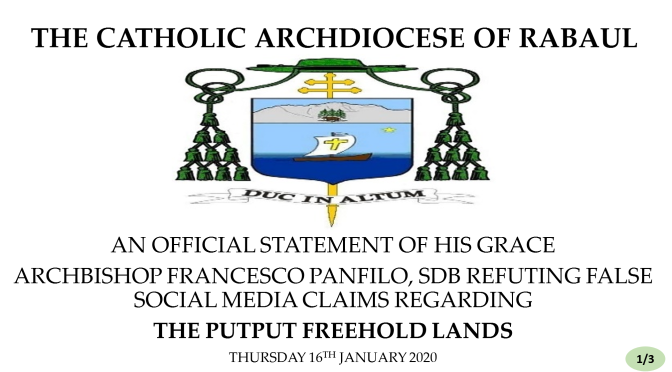
AN OFFICIAL STATEMENT OF HIS GRACE ARCHBISHOP FRANCESCO PANFILO, SDB REFUTING FALSE SOCIAL MEDIA CLAIMS REGARDING THE PUTPUT FREEHOLD LANDS

Thursday 16th January 2020
The Roman Catholic Church of Rabaul would like to inform the general public of the decision of His Honour Kokopo National Court of December 2019, in the case of Roman Catholic Archdiocese of Rabaul v Benjamin Samson and others. (OS No 269 of 2018).

The purpose of this statement is to refute the false statement shared on social media that “the Roman Catholic Archdiocese of Rabaul has no interest in Putput Freehold Lands”. It is important to note that the decision of the Court was only in relation to Portion 808 and not the other four portions which are known collectively as the Putput Freehold Lands. The other portions are:

Portion 580 Marambu Plantation Area: 102.83 hectares

Portion 807 PutPut Plantation Area: 154.11 hectares

Portion 806 Warangoi Plantation: 128.08 hectares

Portion 435: 16,486 hectares.

The total area is around 17,000 hectares. The Roman Catholic Archdiocese of Rabaul lawfully acquired this land, evidenced by a Deed of Transfer in 1966. The Roman Catholic Archdiocese of Rabaul accepts the court decision of December 2019 as it must. Further noting the comments of the Court the Archdiocese is considering its legal options going forward from this decision. The Archdiocese is committed to working on doing what is necessary to ensure certainty of titles to the Putput Freehold Land. This is necessary to ensure fair distribution of the land to the different customary groups who have established customary connections with the land. This will be done free of charge. It is important that the land is distributed in a manner which promotes peace, unity and harmony and not division.

We would like to express our disappointment that we have encountered so many obstacles in attempting to carry out this work. However we remains committed to doing so as it is important that all issues relating to PutPut Freehold land, especially that of appropriate distribution, are addressed once and for all.

Negotiation can only proceed once issues relating to titles are settled.

+Francesco Panfilo, SDB,

Archbishop of Rabaul

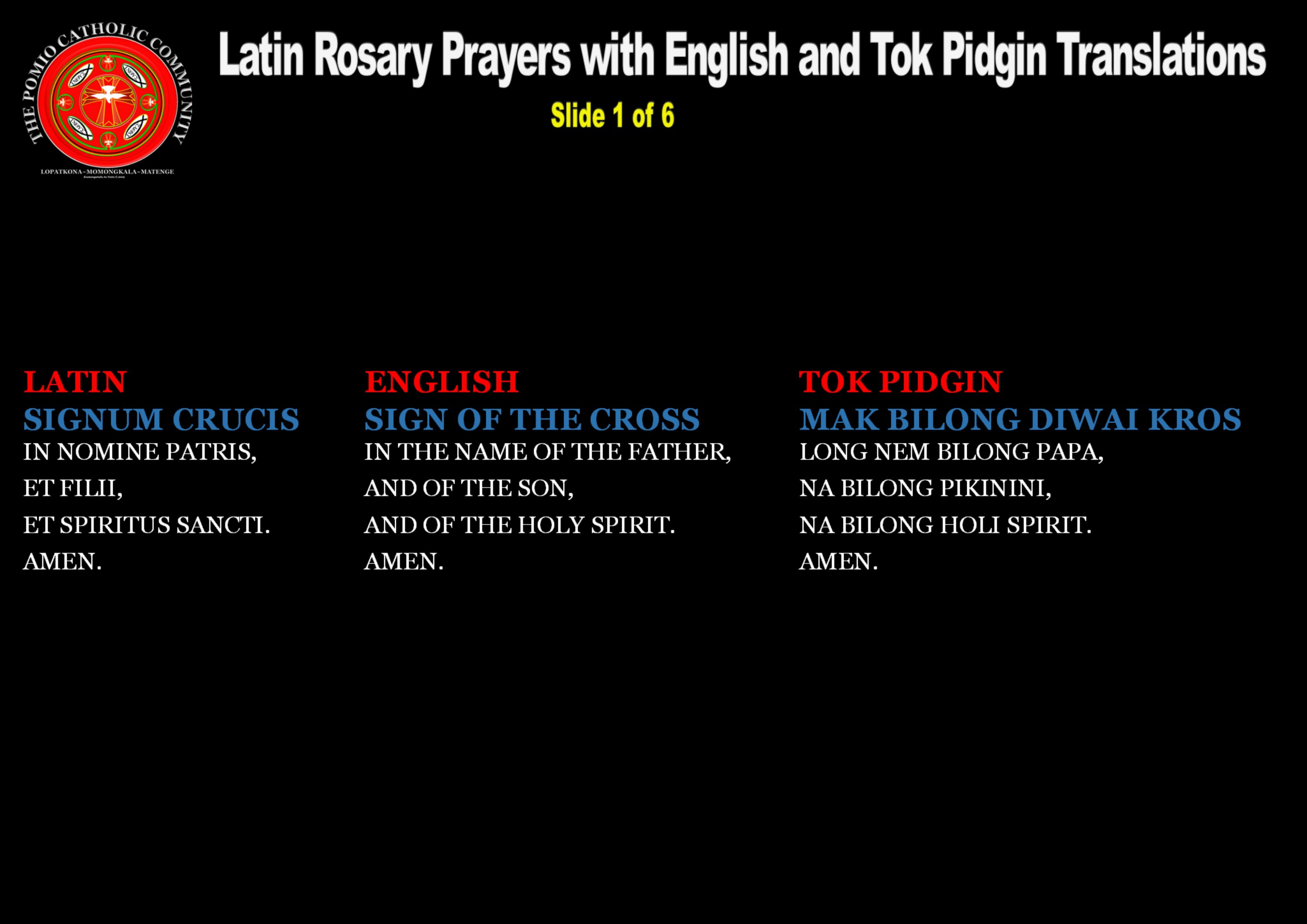
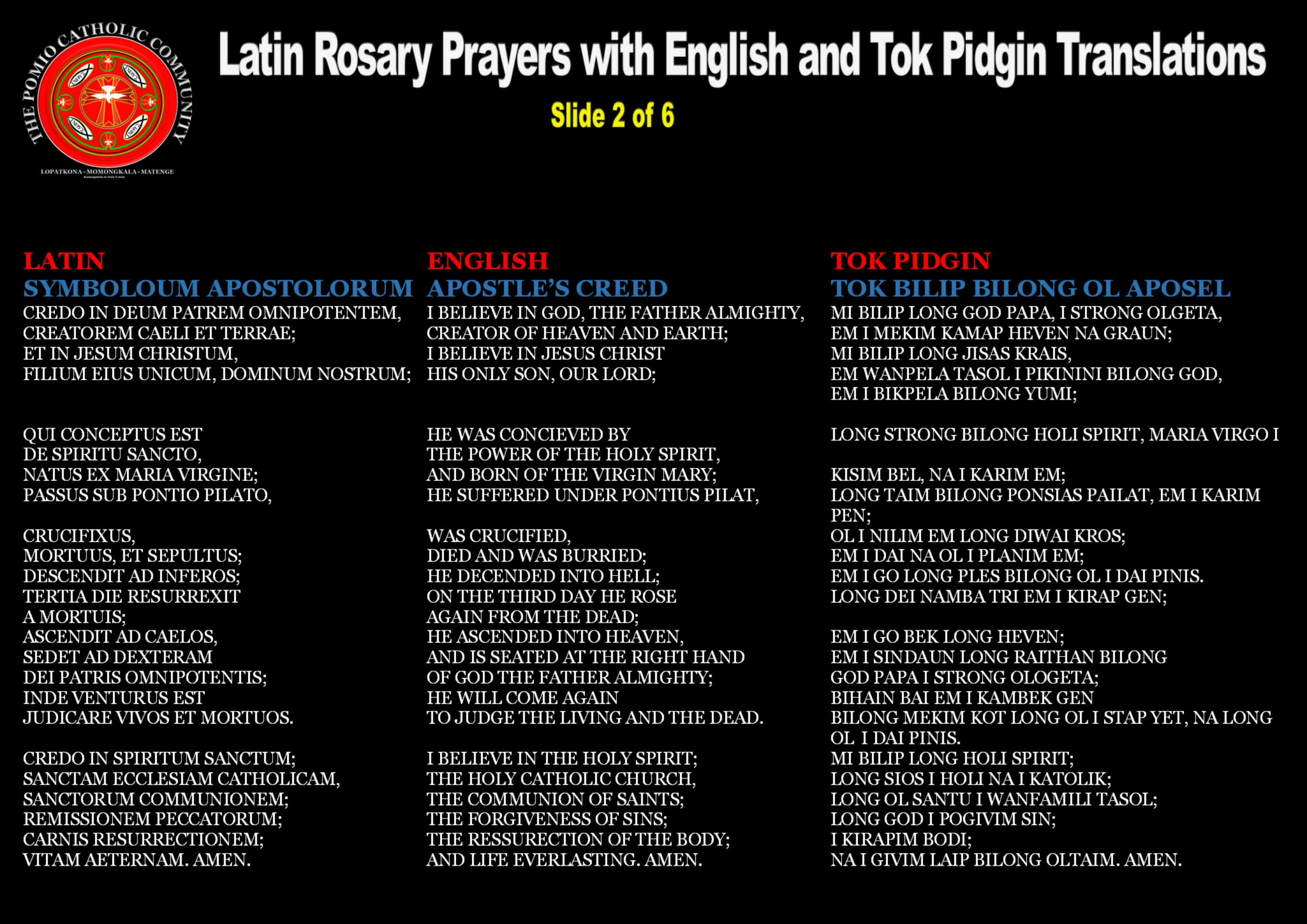
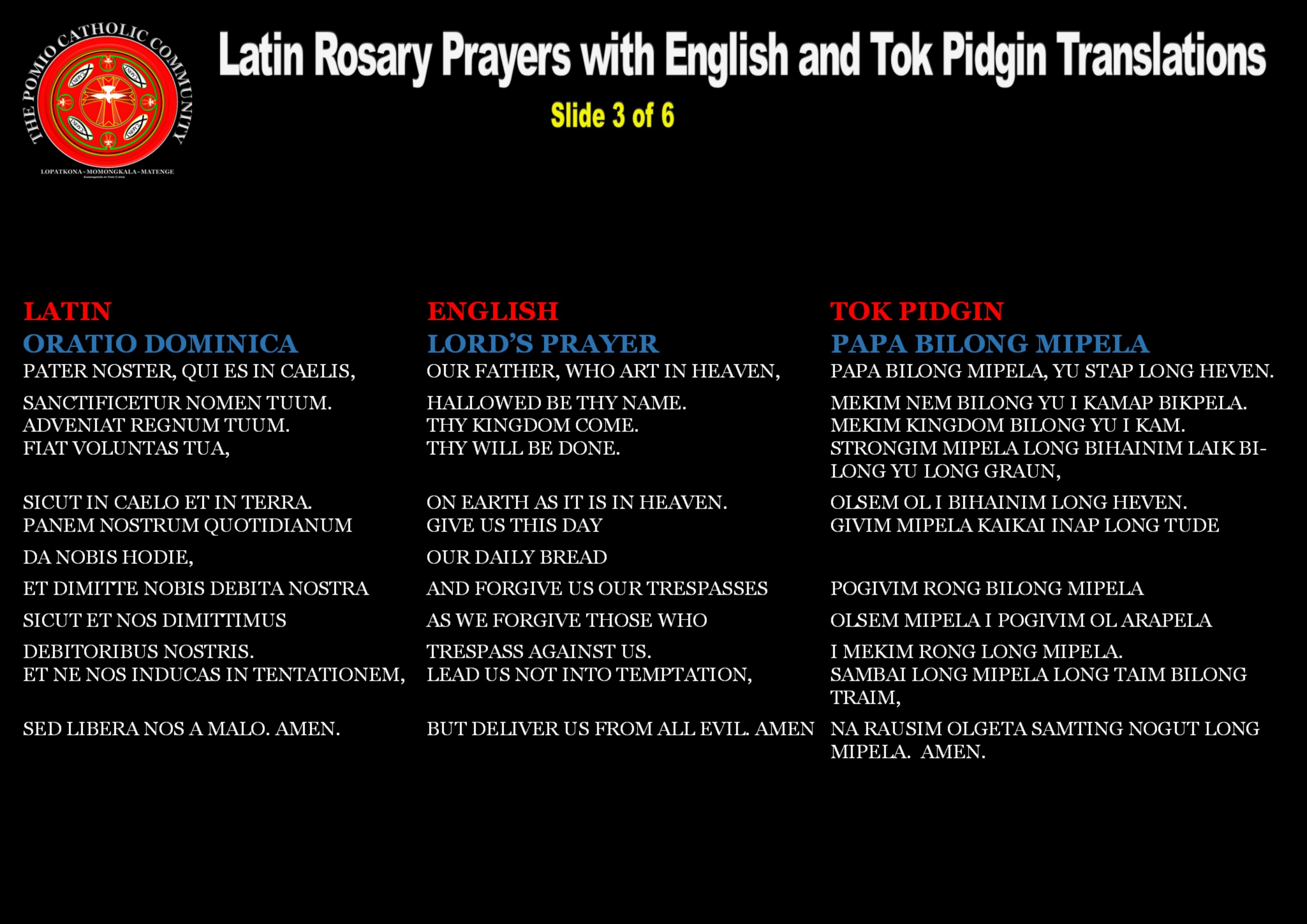
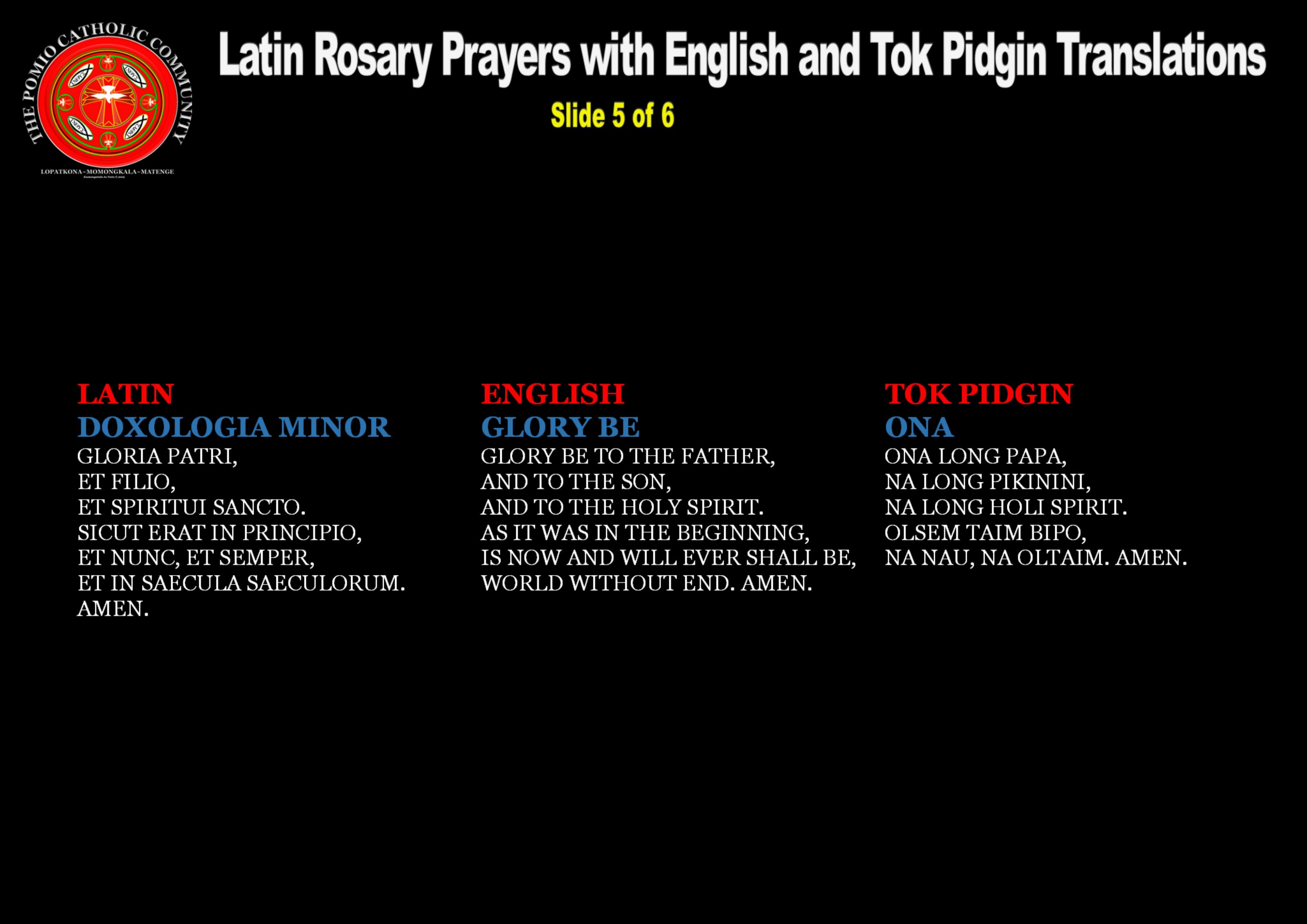
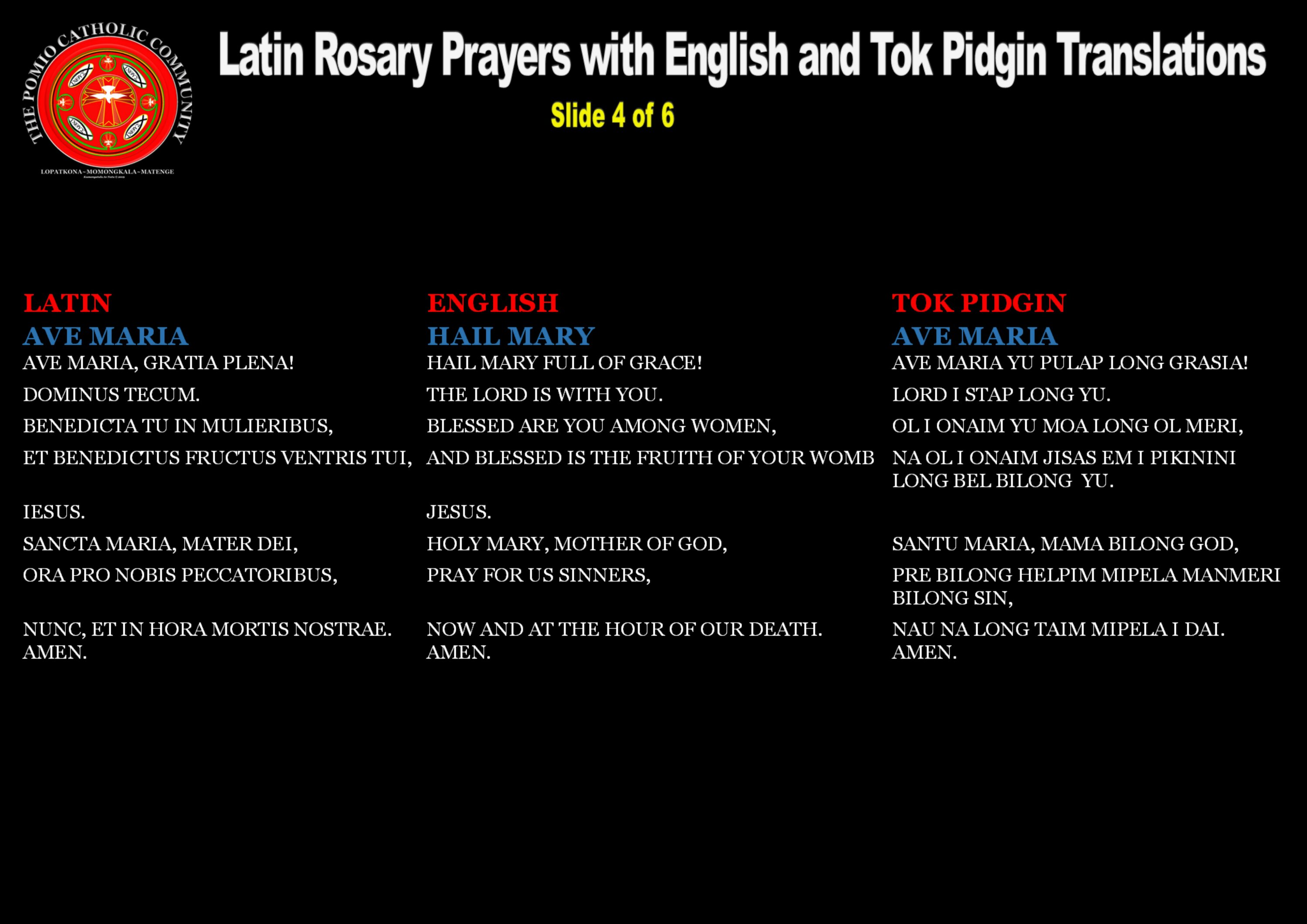
Latin Rosary Prayers with English and Tok Pisin Translations

With a Joyful Heart, we present six infographics of the rosary prayers in Latin with line by line English and Tok Pisin translations to help you learn how to recite the Rosary in Latin, the Official Language of the Catholic Church.

DEO GRATIAS!

R

References:

1. The Boston Catholic Journal
http://www.boston-catholic-journal.com/basic-catholic-prayers-in-latin-and-english-in-audio-format.htm

2. Yumi Lotu Buk
Liturgical Catechetal Institute Goroka, 1990.

Special thanks to Jennie Germale for doing a Proof.